


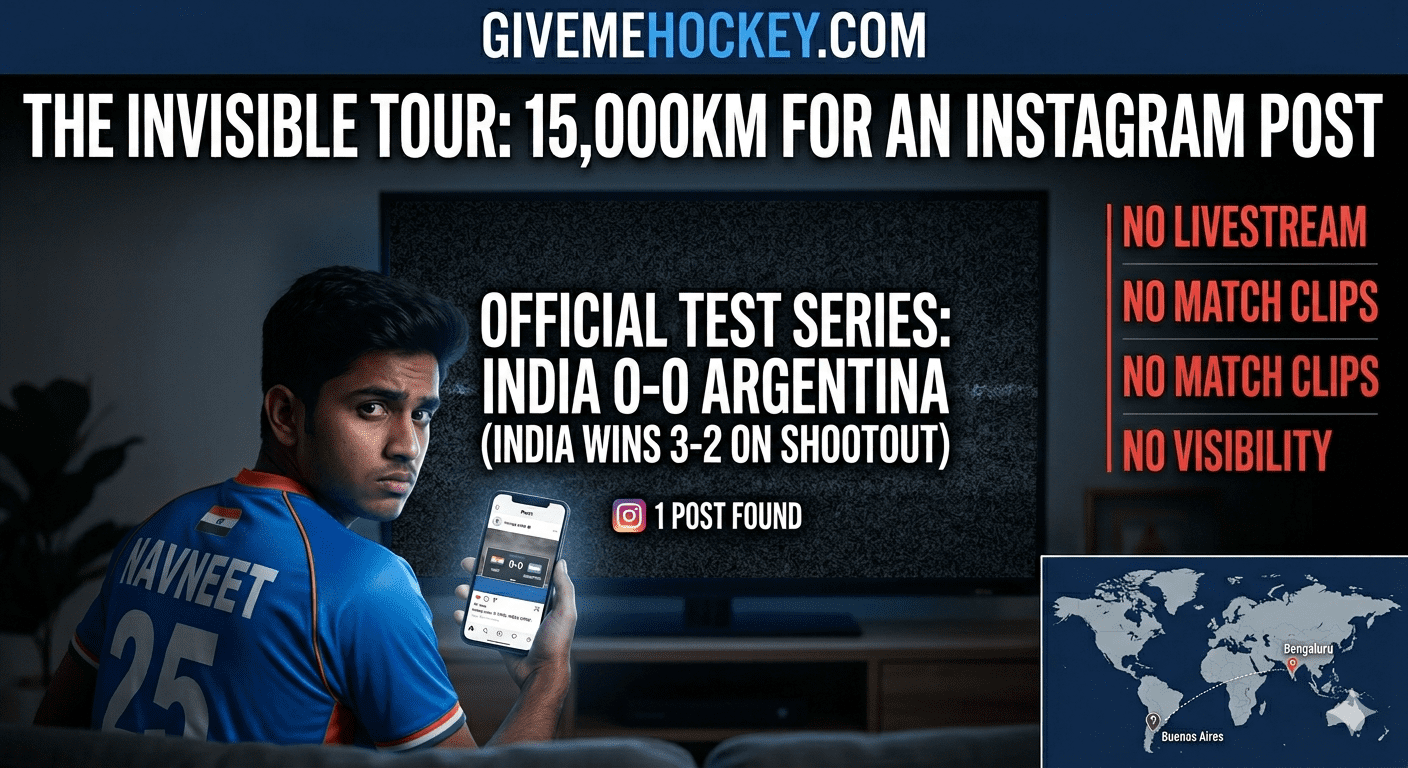
In 2026, Indian hockey fans are still following their national team like it’s 1926: by waiting for a telegram. Except now, the telegram is an Instagram post.
The Indian women’s team just concluded a four-match official Test series against Argentina, the world’s second ranked side. Argentina won the first two games. India, however, won the third. The fourth ended goalless and India won the shootout 3-2. Overall, a decent series and useful preparation ahead of the World Cup later this year. And yet, most Indian hockey fans found out about all of it from one Instagram post. Because that is all there was. No broadcast, no live stream, no match clips, no training videos. In other words, five days of official international hockey against one of the best sides in the world, and the only thing fans could access was a scoreline.
Importantly, this is not a new problem. It is not specific to this tour. In fact, it is how hockey has operated for decades. As a result, it is one of the biggest reasons the sport keeps struggling to grow.
Hockey’s oldest problem
The first question Indian hockey fans ask whenever a tournament is announced is not who is playing or what the stakes are. It is always the same question. Will it be broadcast? Will it be streamed? Fans have been asking this question for forty or fifty years. Unfortunately, the answer has been unreliable for just as long.
For example, domestic tournaments in India, official competitions with ranking implications and national selection consequences, are on Hockey India’s YouTube channel. That is the ceiling for domestic coverage. There is no television deal, no major platform, and minimal reach. Furthermore, the Hockey India League, India’s flagship domestic tournament with international players, was getting an average of 7000 views on YouTube during some games. In a country of 1.4 billion people, that is not a viewership problem. That is a distribution failure.
Similarly, the European Hockey League recently concluded. Unless you are inside the European hockey ecosystem, you could not watch it. A fan who wanted to pay for access found it priced in Euros, thousands of rupees for a few games. In other words, hockey is turning away willing, paying customers and then wondering why the sport does not grow.
Read More: The Mystery of Hockey: Massive Fandom, Stagnant Revenue
Consequently, hockey globally lives in silos. Indian fans cannot access European hockey. European fans have no awareness of Asian hockey. Every federation operates in its own ecosystem. The result is a sport that is fragmented when it should be unified, invisible when it should be growing.
The Argentina tour is the latest example
The India women’s tour of Argentina is a precise illustration of this problem. A 23-member squad flew from Bengaluru to Buenos Aires, one of the longest journeys an Indian sports team can make. Captain Salima Tete could not travel due to illness. As a result, younger players stepped up. Coach Sjoerd Marijne said he wanted to use the tour to play different combinations and see individual and team performances against the number two ranked side in the world.
Showcase themselves. See performances. Those were the coach’s words. And yet, the only evidence that any of it happened is one Instagram post with a scoreline.
Moreover, sending a squad that far involves significant cost. Flights, accommodation, support staff, logistics. That cost, however, creates an opportunity. India vs Argentina, world number 9 vs world number 2, official international hockey. That is content worth having. A broadcast, even a basic one, converts that investment into something fans can see, something that builds the audience hockey needs. Without it, the investment produces nothing beyond the result on a scorecard.
To put it in context, FIH itself acknowledged a few years ago that international travel had become too expensive. That is exactly why they restructured the Pro League from a home and away system to mini tournaments, bringing teams together in one place rather than flying squads back and forth across the world. The commercial logic was simple. If the return does not justify the cost, change the model. Similarly, the Argentina tour is asking the same question differently. If you are spending money to go somewhere, make it count.
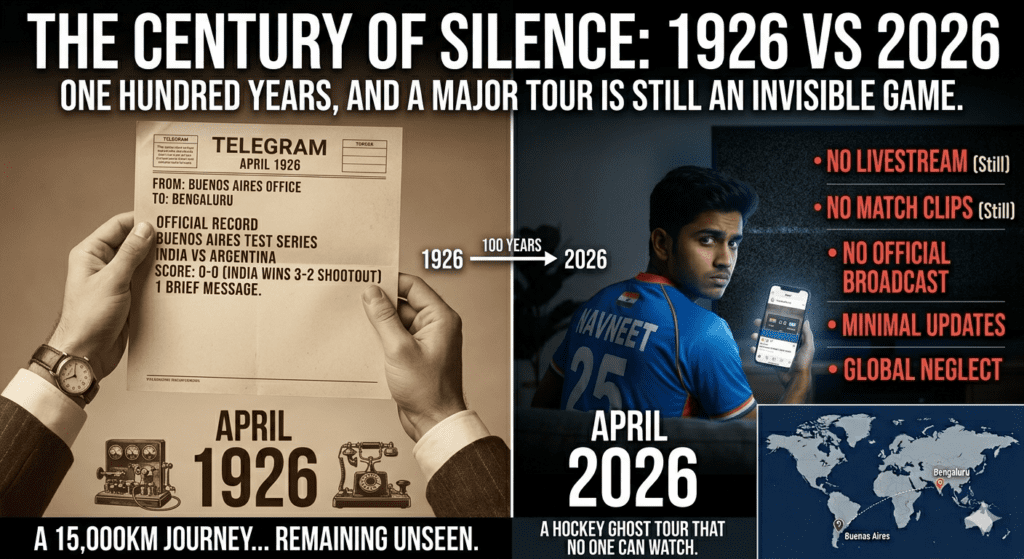
Fans were there. The content was not.
When India plays Argentina in official Test matches, fans notice. Social media fills up with people asking for scores, tagging Hockey India, looking for updates. That organic interest is free marketing. Fans are already engaged, already searching, already willing to watch. All they need is something to watch.
For instance, a live stream converts that curiosity into a viewing habit. A match clip gives fans something to share. A training video builds connection between the team and its supporters. None of this requires a television deal or a production budget. A phone, a YouTube account, and a decision to press record. That’s it, nothing else. Filmmakers shoot movies on iPhones today, why can’t we do the same for sports events?
Instead, fans who went looking for content from the Argentina tour found nothing. Not a goal clip. Not a post match reaction from captain Navneet Kaur or other players. Neither a moment from any of the younger players who stepped up in Salima Tete’s absence. Ultimately, five days of international hockey and the only thing published was a final score.
The World Cup is four months away
This tour was World Cup preparation. Marijne said so. And the World Cup will be broadcast globally. Therefore, fans across India and across the world will be watching.
But broadcast momentum matters. Fans who have followed the team through its preparation, who have seen the combinations being tried, who know which younger players are pushing for a place, those fans arrive at the tournament already invested. On the other hand, a build-up with no visibility produces a fanbase that tunes in cold. Hockey cannot afford cold audiences at a World Cup or on any other day.
What needs to change
The ask is not complicated. If you are sending a squad abroad for official Test matches, make those matches visible. Not necessarily on television. Not on a paid platform. Simply go live on YouTube. Post match clips on Instagram. Share a training video. Show fans that something is happening and give them a reason to follow.
Above all, visibility is not a nice to have. It is the foundation on which sponsorship, broadcast deals, grassroots growth and long term sustainability are built. A sport that cannot be watched cannot grow. And a sport that does not grow will always be chasing money instead of attracting it.
The World Cup is coming. India vs Argentina, official Test matches, world number 9 vs world number 2, was exactly the kind of series that builds excitement for what is ahead. Fans wanted to watch. The content existed. Someone just needed to share it.