


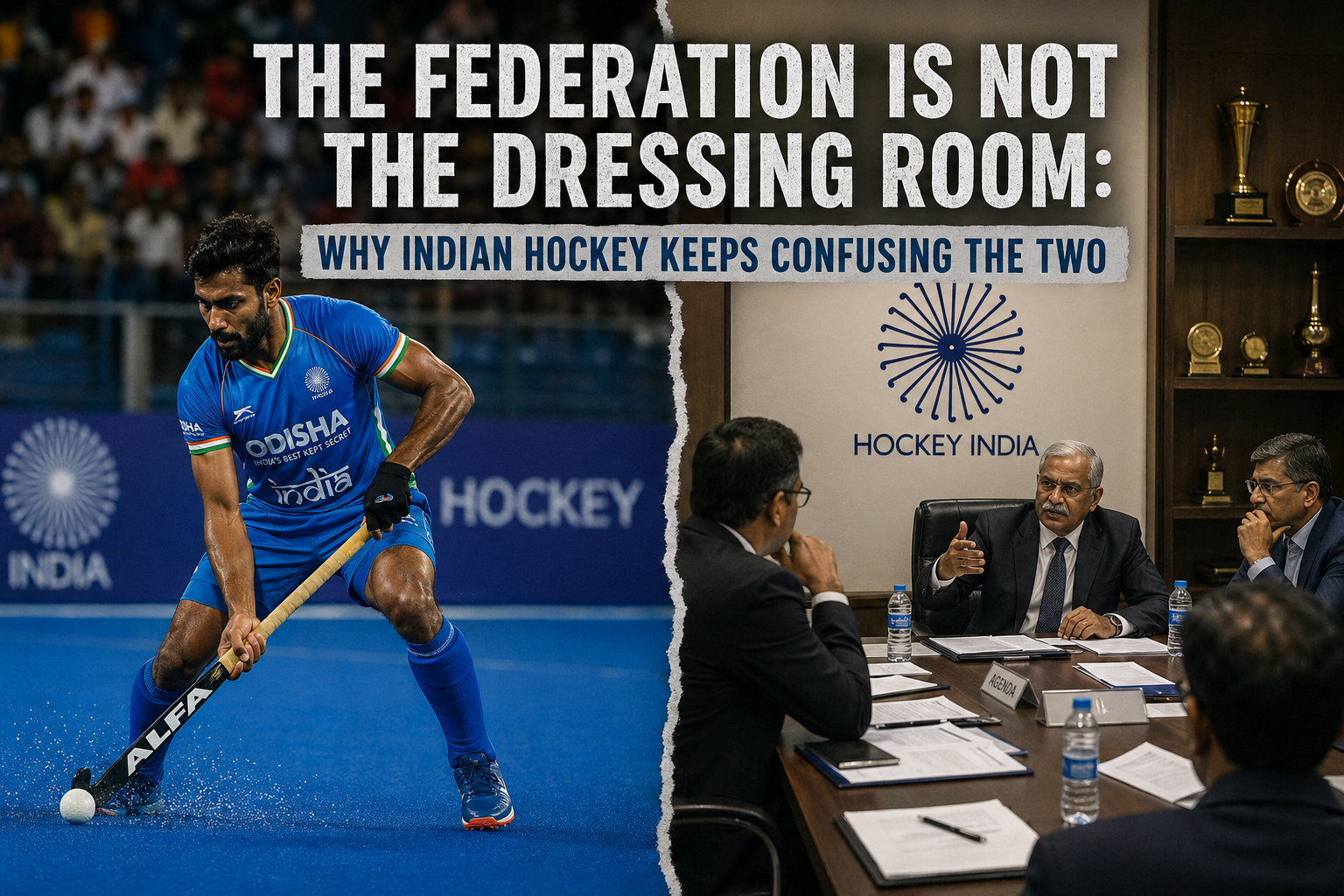
There is a romantic idea that has taken hold in Indian sport: former players, people who have lived the game, felt the pressure of the big match, understood what it means to represent the country, are best placed to run the federations that govern those sports. It sounds compelling. It is also, in most cases, not true. Hockey India is the clearest example of this right now.
Hockey India’s current president Dilip Tirkey, a former India captain with 412 international caps and one of India’s finest defenders of his generation, is the president of Hockey India. He brings legitimacy, a clean image, and genuine love for the sport. What he has not brought, at least not visibly, is the kind of administrative and commercial capability that the federation actually needs.
Compare his tenure to that of Narinder Batra. Batra had serious controversies. The IOC eventually banned him. But whatever Batra’s failings as a person, he transformed what Hockey India was in the world. He silenced the retired-player commentary that had dogged Indian hockey for years, the kind where former stars would publicly second-guess every selection and every tour.
Under his watch Hockey India’s political standing in world hockey rose sharply. He became FIH president. India had a seat at the table in global hockey decisions in a way it had never had before. Batra understood how to work a system, how to build influence, how to make Hockey India a name that mattered in global sport. That is a specific skill and it has nothing to do with how many goals you scored.
A great player and a great administrator are two entirely different people. Confusing the two is a governance failure, not a compliment.
The Hockey India League Problem
The Hockey India League is the most visible test of the current administration’s capability. Bringing the league back after years away deserved every bit of celebration it got. The HIL in its original avatar was genuinely exciting and helped build a generation of Indian hockey fans. But bringing something back and building something sustainable are two very different things.
The questions that any competent sports administrator would ask from day one are: what does this league cost per season, what does it earn, what is the broadcast deal worth at the federation level, what is the franchise model and does it create self-sustaining stakeholders, and what does the five year vision look like? This is not a complicated question. They are basic business questions. And from everything that has been visible publicly, Hockey India has not answered them in any meaningful way.
Hockey India League 2.0 runs more on enthusiasm and government support rather than commercial discipline. It feels like the federation was more interested in the optics of bringing the league back than in understanding why it failed the first time.
Hockey India, like most Indian sports federations, remains heavily dependent on government funding. The Sports Authority of India, the Ministry of Youth Affairs and Sports, state governments like Odisha that have invested heavily in the sport. Private revenue, the kind that makes a federation genuinely independent and sustainable, has not grown the way it should have under the current leadership. Running a federation is ultimately a business. And a business requires revenue that does not come from government handouts.
The Real Power and the Real Problem
There is another dimension to this that rarely gets discussed openly. In most federations, the president is not actually the person running day to day operations. The secretary general is. And when a federation has a ceremonial president who brings a famous name but limited administrative experience, the real power shifts entirely to the secretary general and the professional staff. This is not unique to Hockey India. The BCCI has operated similarly for years, with presidents serving largely ceremonial roles while the operational machinery runs through the secretary and the professional layer.
The problem is not that this structure exists. The problem is when the administrative layer running things is not accountable in the way it should be. When a senior Hockey India official publicly defends a coaching decision by citing his own background in a completely different sport as his qualification, that is not a governance structure working well. That is a governance structure that does not understand the difference between process and results. The federation’s job is to create conditions where the right people are in the right roles, coaches are appointed on merit, and decisions are made based on evidence. When administrative ego starts driving technical decisions, players and coaches pay the price.
What the Best Federations Actually Do
Look at the federations running the most successful hockey programmes in the world. The Netherlands, Australia, Belgium. In each case, former players are present in the system, but in technical roles. High performance directors, coaching pathway heads, selection committee members, athlete welfare advisors. Their experience is used where it is actually relevant: understanding what a player needs, what a training environment should look like, what it means to perform under pressure.
Professional sports administrators run the commercial and administrative machinery in each of these federations. The KNHB in the Netherlands is led by president Erik Klein Nagelvoort, a former international umpire and long-time partner at PricewaterhouseCoopers who owns a data marketing company. Hockey Australia’s CEO David Pryles came from Softball Australia, appointed specifically because the federation wanted someone with a proven commercial background. These are deliberate choices. People with backgrounds in sports business, broadcast negotiation, stakeholder management, financial planning. Not people who earned the role because of what they did on the pitch.
Belgium’s remarkable rise as a hockey nation is instructive here. It was not driven by a former Red Lion sitting in an administrative chair. It was driven by systematic investment in professional coaching structures, data analytics, and long term planning. That is an institutional capability, not a playing credential.
The National Sports Development Code of India, 2011, already mandates athlete representation on executive committees. That is the right structure. Athlete voice in the room matters. Players should have a seat at the table, input on selection philosophy, player welfare policies, and development pathways. But athlete voice in the room is very different from athlete at the head of the table by default, without the skills the role actually demands.
Read More: From Telegram to Instagram: Indian Hockey Still Has a Visibility Problem
Right Person, Right Role
This is not an argument against former players in administration. It is an argument for putting the right people in the right roles. A former player who has also built genuine administrative and commercial skills is exactly the kind of person you want running a federation. But the playing career alone is not the qualification. It has never been the qualification.
Hockey in India today is standing at an important juncture. The World Cup is coming. The Asian Games follow. LA 2028 is on the horizon. The HIL needs to become financially self-sufficient or it will remain a vanity project. The women’s team is rebuilding. The men’s team is trying to rediscover consistent form. All of this requires a federation that is run with commercial discipline, strategic clarity, and genuine accountability. And right now, that is exactly what is missing.
A great player does not automatically become a great administrator. The skills are almost entirely non-overlapping. What Indian hockey needs at the helm of its federation is not the most decorated name in the room. It is the most capable one.
The question of whether Hockey India currently has that capability, and what the federation’s own documents reveal about how it is actually being run, is something we will look at in detail in Part 2.
An Appeal
Today, theSocial media algorithms decide what you see and when you see it. Somewhere in that noise, this kind of writing gets buried. If you want to support the work, subscribing on Substack is the easiest way. Every piece lands directly in your mailbox.
Please Subscribe to Give Me Hockey Substack