


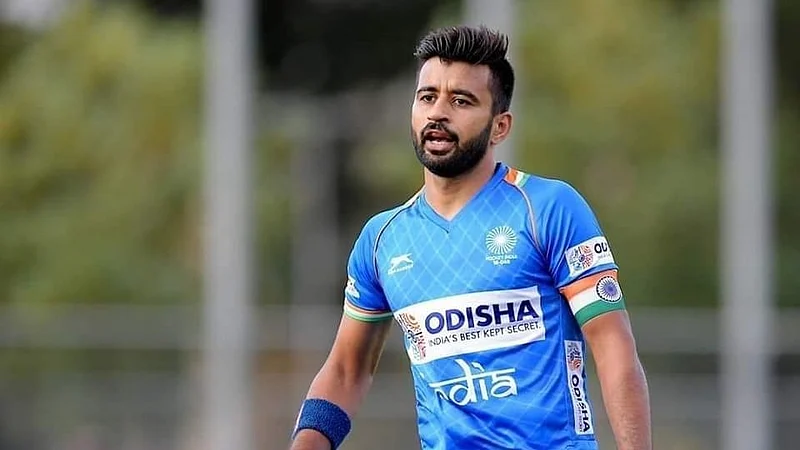
In the fourth minute of India’s wooden spoon match at the 2012 London Olympics, Manpreet Singh was struck on the head by South Africa’s Lloyd Norris-Jones’ swinging stick and stretchered off the field.
The tournament was already over for India. They had lost every single game. Manpreet was just 20 years old. He could have sat out the remaining 65 minutes and nobody would have said a word.
Instead, he came back for the second half with a large bandage around his head.
Nobody asked him to come back. He just did.
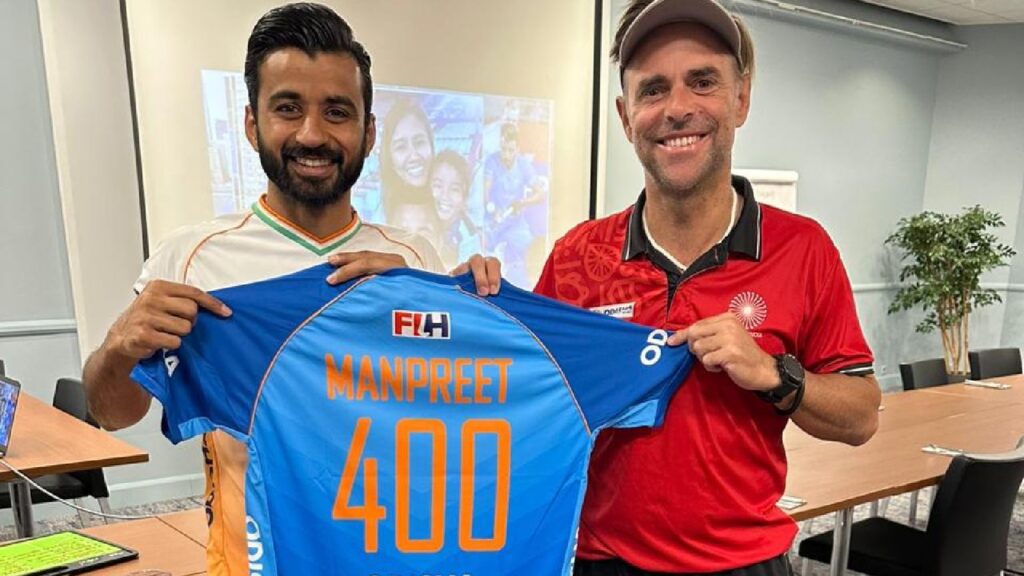
Thirteen years later, he stands one cap away from becoming India’s most capped player of all time. He has 411 international appearances, one short of Hockey India President Dilip Tirkey’s record of 412. The European leg of the FIH Pro League is where that record could fall. Thirteen years defined by running India’s midfield, supporting the attack, anchoring the defence, and never once stopping. Serious on the pitch, a prankster off it. Selfless when it mattered most. Still going.
The Korean from Mithapur
The nickname Korean was given to him by former India defender Jugraj Singh, who spotted Manpreet as a child playing village matches in Jalandhar. Similar to Korean players, Manpreet had quick feet, sharp movement, and a lightness to how he carried himself on the pitch. The name stuck.
Years later, when Jugraj recommended him to then India coach Harendra Singh for the national camp, he said simply: “That Korean kid has something about him.”
The nickname turned out to be more accurate than Jugraj perhaps intended. Korean culture is built on collectivism, on putting the needs of the group above personal desire, on loyalty that runs deeper than convenience. Those who have watched Manpreet would say that description fits him as well as any label ever has.
Manpreet’s first real inspiration was Pargat Singh, the former India captain who led the side at the Barcelona 1992 and Atlanta 1996 Olympics. Pargat was a defender who carried the ball forward like a midfielder, covering the full length of the field and refusing to be confined to one role. Manpreet would build his career in much the same way.
He broke into the national team as a left half before eventually inheriting the central midfield role from Sardar Singh. For the next decade he became the engine of India’s midfield, linking defence and attack while covering every blade of grass in between. When India needed control, Manpreet provided it. When India needed intensity, he brought it. And when India needed someone to carry the ball through pressure, he was often the first option.
Read More: What do we know about Hockey India League Season 3?
Character First
The Sultan Azlan Shah Cup is not the Olympics. It is not the World Cup. In the grand scheme of a hockey career, it is a preparatory tournament. Nobody would have questioned Manpreet Singh had he chosen to stay home after his father passed away during the 2016 edition in Ipoh.
He came back anyway.
After rushing home to Jalandhar for the funeral, he flew straight back to Malaysia, mid-tournament.
He didn’t return for a medal or a record; he returned for his teammates, the jersey, and a quiet, lifelong obligation to the group. Within four minutes of stepping back onto the pitch against Pakistan, he scored.
He has never made it a story about himself. That moment, like so many others in his career, belongs to the team in his mind. Not to him.
It was the same impulse that had driven him back onto the field in London with a bandage around his head. Not because anyone asked. Not because the result mattered. But because leaving the field early was simply not something he was built to do.
Faced with injury, he came back. Faced with personal loss, he came back. Whenever Indian hockey needed him, he came back.
Read More: India Beat Japan; Win Men’s U18 Asia Cup 2026
The Captain Who Ended 41 Years of Waiting
When Manpreet was appointed captain in 2017, Indian hockey was searching for consistency. There had been flashes of progress. There had been memorable victories. But one statistic still hung over the team. India had not won an Olympic medal since Moscow 1980.
At the opening ceremony of the Tokyo 2020 Olympics, Manpreet Singh carried the Indian flag. The last hockey player to have done so was Pargat Singh at Atlanta 1996. The same man who had inspired a young boy from Mithapur to pick up a stick. Twenty-five years later, his student walked in his footsteps.
India won bronze. For the first time in 41 years, India stood on the Olympic podium again. Manpreet was the captain.
In 2019, he had become the first Indian to win the FIH Player of the Year award since it was introduced in 1999. He dedicated it to his late father.
Selfless to the End
Elite sport moves quickly. New coaches arrive. The systems emerge. New players challenge for places. Few athletes survive long enough to experience multiple cycles. Fewer still remain important throughout them.
As Hardik Singh developed into one of the world’s best midfielders, Manpreet did not resist. He stepped back from the captaincy, shifted his role, and found another way to contribute. Not every senior player can do that. Most either fight for what they had or quietly disappear. Manpreet did neither. He simply found a new way to be useful.
At Paris 2024, India faced Great Britain with ten men after Amit Rohidas received a red card. The game stopped. The team huddled. Manpreet Singh, no longer captain, no longer the central midfielder, stood up and spoke. In Punjabi. Loud enough for everyone to hear. The message was simple. Nobody lets the ball into the D. Nobody drops their guard. Not now.
India held on, and beat Great Britain in penalty shootouts.
That is Manpreet Singh. Not the most capped player yet. Not the captain anymore. But still the one the team turns to when it matters.
Read More: Indian tadka in Australia’s Hockey One League
Manpreet Singh Career Honours
| Achievement | Detail |
| International Caps | 411 (and counting) |
| Olympic Medals | Bronze, Tokyo 2020; Bronze, Paris 2024 |
| Asian Games Medals | Gold, 2014; Bronze, 2018; Gold, 2022 |
| Commonwealth Games Medals | Silver, 2014 |
| FIH Player of the Year | 2019 (first Indian to win the ward) |
| AHF Junior Player of the Year | 2014 |
| Olympic Flag Bearer | Tokyo 2020 |
| Sultan of Johor Cup | Gold, 2013 (as junior captain) |
The Record
Dilip Tirkey’s record has stood for years. The former defender represented India 412 times across an era when international hockey looked very different from today.
Now Manpreet is about to join him. The next match will bring him level. The one after that will likely see him stand alone.
The willingness to play through pain in London. Returning to the team after losing his father. Leading India to an Olympic medal after a 41-year wait. Accepting new roles when younger players emerged. Showing up, year after year, whenever India needed him.
That is what 413 caps will mean.
The boy who came back with a bandage around his head in London 2012 has no intention of stopping.
Indian hockey is heading into its biggest summer in years. Nations Cup. World Cup. Asian Games. Manpreet Singh could make history before it even starts. Subscribe to the Give Me Hockey newsletter and follow every step of it.