

India’s disappointing World Cup has changed plenty of conversations around the team. The expectation for the Asian Games remains the same: India should arrive in Aichi-Nagoya as the clear favourites for gold.
The level of opposition is very different. India are defending champions, Pakistan are the one team most likely to make a final uncomfortable, and Malaysia deserve some caution because they have troubled India in major Asian tournaments before. India still have enough quality to top the pool, win the semi-final and enter the gold-medal match expecting to win it. Hockey India has confirmed that India will defend the title they won at Hangzhou 2023.
The more interesting part of the tournament is how India get there. Harmanpreet Singh’s penalty corners should become an even bigger weapon against weaker opposition, the midfield has a chance to show something that was largely missing at the World Cup, and the team needs to leave the disappointment of that tournament behind while carrying the lessons into Japan.
The World Cup Has Not Changed India’s Gold Expectation
India finished eighth at the World Cup, a poor return for a team that entered the tournament with much higher expectations. The Asian Games presents a completely different level of competition, and India should still be judged as the strongest team in the continental field.
Their Pool A opponents are Indonesia, Sri Lanka, Korea, hosts Japan and Bangladesh. Pakistan and Malaysia are both on the other side of the draw. India begin against Indonesia on September 20 before facing Sri Lanka, Korea, Japan and Bangladesh.
India should top that pool. Japan and Korea can make individual matches competitive, although neither should prevent India from reaching the semi-finals. If the tournament broadly follows the expected hierarchy, India should also enter the semi-final as favourites.
The difference in opposition should change the way India are able to play. At the World Cup, stronger teams could force India into longer defensive spells and make quick transition one of their clearest routes forward. Most Asian Games opponents should give India far more possession, territory and time to decide how they want to attack.
Anything short of the final would be a major disappointment. Gold remains the expectation because India still have more quality than anyone else in the tournament.
Read More: High Stakes, Low Magic: Why the Asian Games Feels Flat After the World Cup
Harmanpreet Singh Gives India a Major Penalty-Corner Edge
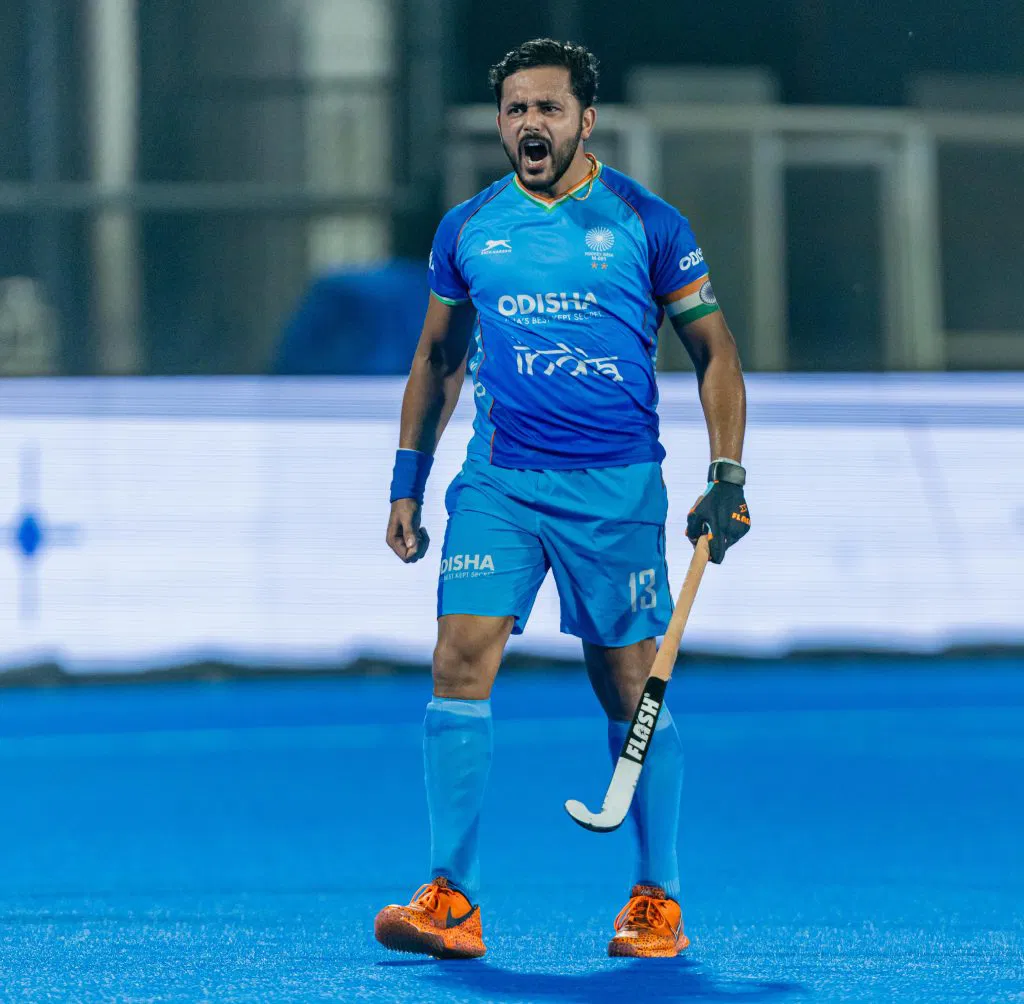
Harmanpreet Singh remained India’s biggest source of goals during an underwhelming World Cup. He scored eight goals in six matches, with all eight coming from penalty corners. India scored nine penalty-corner goals as a team, the highest total at the tournament.
The Asian Games should increase the value of that weapon. India are likely to spend much more time around the opposition circle against weaker teams, creating more situations where defenders have to make tackles under sustained pressure. A higher volume of circle entries should also give Harmanpreet more opportunities from the top of the circle.
His World Cup numbers are especially significant because the set piece remained productive during a tournament where much of India’s attacking hockey did not work consistently. Harmanpreet scored eight of India’s 17 goals, while the team’s nine penalty-corner goals were the highest total in the competition.
The knockout rounds may make that advantage even more valuable. Tight semi-finals and finals are often decided by one major moment, and India have one of the strongest penalty-corner specialists in the field.
Read More: Asian Games 2026 Men’s Hockey Schedule: Pools and Fixtures
Pakistan Can Disrupt India’s Game
Pakistan are the opponent India should respect most. Their hockey can become physical and direct, while the individual quality in the side gives them the ability to disrupt the rhythm of a game India would otherwise expect to control.
The World Cup meeting showed why. India raced into a 3-0 lead through Harmanpreet Singh and Abhishek and eventually won 5-3. Pakistan continued finding ways back into the contest, with Sufyan Khan scoring through a powerful drag flick as the match became less comfortable for India.
Sufyan gives Pakistan a serious penalty-corner threat. He scored five goals from penalty corners during the 2025-26 Pro League and another three from penalty corners at the World Cup. A match that becomes physical and produces cards or penalty corners can quickly give Pakistan opportunities to stay involved.
India’s greater attacking quality was still clear in that World Cup meeting. They created the early three-goal cushion and eventually found five goals, yet Pakistan’s physicality, individual skill and penalty-corner threat kept the contest alive longer than India would have wanted.
Malaysia remain the other side worth watching because of their history of causing India problems. Their current level gives little reason to expect another major upset, although that history is enough reason for India to avoid treating a knockout meeting casually.
Can India Build Through the Midfield?
The midfield is the most interesting tactical question of India’s Asian Games campaign. At the World Cup, there were long periods where the centre of the pitch appeared almost empty when India attacked. The preference for quick transition meant the ball could travel rapidly from defence towards the forwards, leaving a noticeable gap between the lines when the initial attacking move slowed down.
India then struggled to sustain attacks. Once the first transition ended, there was often no obvious midfield platform to recycle possession, move the ball to another side of the pitch or build another phase. The defence and forwards could look like two separate units rather than parts of the same attacking structure.
The Asian Games provides a much better environment to test another approach. Many opponents are likely to defend deeper and deny India the open space required for quick transition, forcing India to spend longer periods building against organised defensive blocks.
The midfield should become central in those situations. India will need to move the ball across the pitch, recycle possession when the forward route is closed and use several passes to create an opening rather than always searching for immediate speed.
There is a useful football comparison here. Teams that control matches can start from the back, use midfield to dictate tempo and keep moving the opposition until space appears further forward. India have enough technical quality to build attacks in a similar way.
Hardik Singh, Manpreet Singh, Vivek Sagar Prasad, Nilakanta Sharma, Raj Kumar Pal and Rajinder Singh give India plenty of midfield quality. The Asian Games should show whether that group can control matches through the middle and give India another way of attacking when transition is unavailable.
Read More: Craig Fulton’s World Cup Problem: Where Was India’s Plan B?
India Need to Forget the World Cup, but Remember the Lessons
India also need to show that the disappointment of the World Cup has been left behind. The clearest concern came against Argentina. India’s body language changed as early as the second quarter. Shoulders dropped, the energy disappeared and the team looked as if it had already accepted where the game was heading. Argentina had scored after only 39 seconds and eventually won 5-3, with India’s final two goals arriving in the closing minutes after the result was effectively gone.
The visible response is enough to raise a question about how India react when an important match starts moving away from them. At the Asian Games, a difficult quarter in a semi-final or final cannot be allowed to dictate the rest of the contest.
The tactical lessons from the World Cup remain useful. India saw what happened when the midfield became disconnected, when quick transition became too important and when stronger teams disrupted the way they wanted to play. Those problems should inform what India work on in Japan.
The early pool matches provide an opportunity to rebuild rhythm. India start against Indonesia and Sri Lanka before facing Korea, Japan and Bangladesh, which gives them time to settle into the tournament before the knockout rounds.
The approach will be worth watching from the first match. India can retain the defensive security that Craig Fulton values while giving the midfield a much larger role in possession and attacking more aggressively when the game allows it. A team capable of switching between those approaches will be much harder to disrupt.
Gold Should Still Be the Expectation
India enter the Asian Games as defending champions with the strongest overall squad in the continental field and a penalty-corner weapon in Harmanpreet Singh that should punish teams forced into long defensive spells. Their World Cup disappointment gives them plenty to correct, but it does not make the Asian Games field suddenly stronger.
Pakistan can make a final difficult, particularly if the match becomes physical and Sufyan receives penalty-corner opportunities. Malaysia have their history of troubling India, while Japan and Korea can make individual matches competitive. India should still be expected to finish above all of them.
India should top the pool, reach the final and win gold. The more interesting part will be what the hockey looks like on the way there.
Can the midfield control matches instead of leaving a hole through the centre? Can India build attacks patiently when transition is unavailable? Can Harmanpreet continue turning territorial pressure into penalty-corner goals? And if a knockout match starts badly, can India avoid the body language seen against Argentina?
The Asian Games gives India an immediate chance to show what they learned from the World Cup. A better-connected midfield, the ability to maintain intensity when a match turns difficult and Harmanpreet continuing to deliver from penalty corners should leave India with enough to defend their title.
We will be covering the Asian Games through our Asian Games 2026 Hub. Make sure to bookmark it for all the Indian hockey related information.
You can join us on Substack and get all the articles and personal view right in your inbox. Subscribe now.




Comments are closed for this article.