
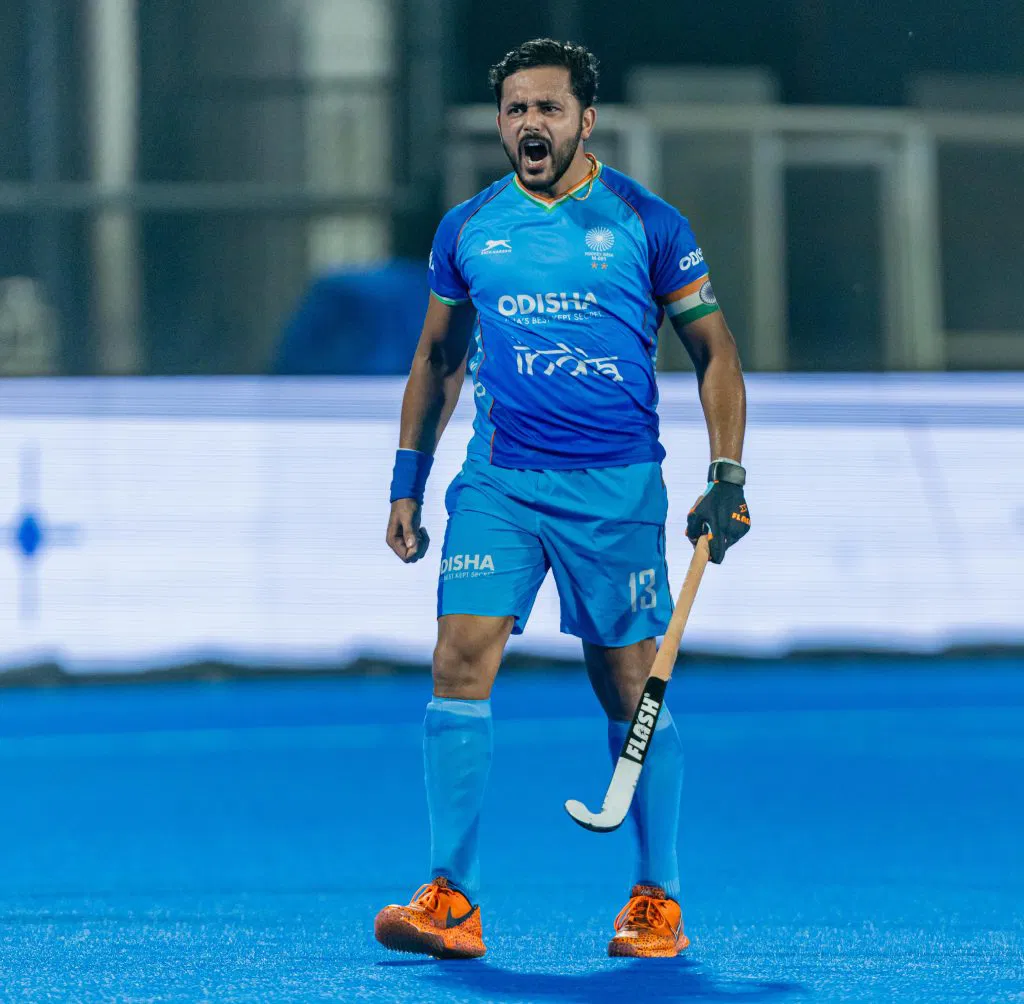
Harmanpreet Singh has spent the better part of a decade as India’s most important defender. He has led the side since 2022, he remains India’s primary penalty corner option, and few players have done more to define how this team plays without the ball. None of that is in question.
What is worth asking, with the World Cup two months away and India still searching for the right balance across the pitch, is whether the position he plays is actually the one that gets the most out of him.
This analysis is based on video review of India’s FIH Pro League matches against Netherlands and Germany in Rotterdam, alongside the goals conceded record from the Rourkela and Hobart legs earlier in the season.
His defensive role has always been straightforward on paper, the last man back, the player whose positioning underpins everything India do without the ball. But increasingly, the question is not whether Harmanpreet Singh matters to this team. It clearly does. The question is whether defence is actually the role he should be playing.
Harmanpreet Singh’s Defensive Positioning
The numbers from India’s home leg in Rourkela were stark. India lost all four matches, conceding 19 goals, including an 0-8 defeat to Argentina. Harmanpreet was rarely visible in the frame during defensive sequences, effectively playing India a man down at the back. His recovery runs were slow.
He then took personal time away from the squad and missed all four matches of the Hobart leg in Australia. India still could not win in regulation, but defensively the picture changed. India conceded just 6 goals across those four matches, compared to 19 in Rourkela. That swing does not prove Harmanpreet’s positioning caused Rourkela’s defensive collapse, a small sample across two legs against different opponents has obvious limits, but it is a real enough shift that it deserves notice.
A similar pattern showed up again against Netherlands in Rotterdam. India conceded an early goal in the second minute. From what was visible, Harmanpreet’s positioning looked partly responsible. Two minutes later, with India defending, he was seen standing next to Jarmanpreet Singh, more focused on watching the ball than actively engaging with the play in front of him. Two separate moments inside the opening four minutes, both pointing to the same concern.
Read More: FIH Pro League 2025-26: 5 Things to Watch as India Heads to Europe
The Vision and the Passing
What makes this complicated is that in the same matches where his positioning was a concern, Harmanpreet Singh was also directly responsible for some of India’s best attacking moments.
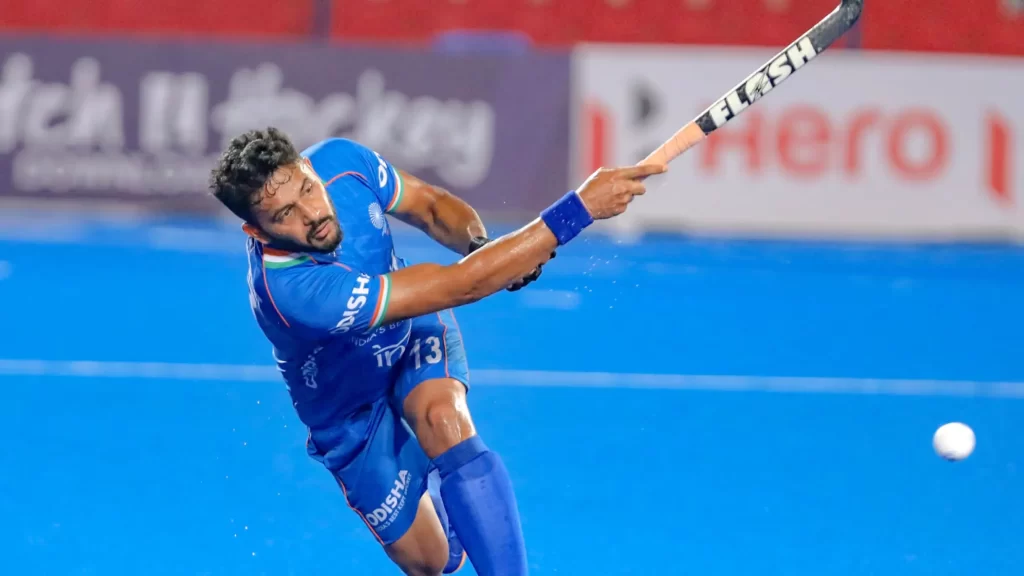
In the sixth minute against Netherlands, he sent an aerial ball to Jarmanpreet Singh on the right with pinpoint accuracy, the kind of pass that requires real anticipation and vision to execute. Later in the same match, positioned between India’s own circle and the 5-metre line, he hit a long diagonal slap shot across the width of the pitch to the opposite flank, finding Dilpreet Singh open. Dilpreet scored India’s first goal from that pass.
Against Germany, the pattern repeated. In the sixth minute, India won a free hit near the halfway line. Harmanpreet Singh received it with his back to play, looking set to pass backward. Germany’s defenders shifted to cover that pass. Instead, he played a quick self-pass and released the ball forward with a stick movement too fast to track, beating at least two defenders who had been covering passing lanes. Later in the match, he hit another slap shot from just before the 25-yard line that cut through seven German defenders, the ball running through to Shilanand Lakra, who scored India’s second goal.
Four moments, two matches, the same skill on display each time, a long, accurate pass that finds a teammate in space and turns defence directly into a scoring chance.
Is a Defensive Midfield Role the Answer?
There is a tactical knock-on effect worth considering here. Right now, because India often struggle to progress the ball cleanly from the back, Hardik Singh has had to drop deep into India’s own half to get on the ball and start attacks himself. That takes Hardik further from the opposition’s defensive third, the area where his ability to create and finish matters most.
If Harmanpreet Singh were consistently doing the job of progressing the ball from deep, the long diagonal passes, the disguised forward balls, Hardik would not need to retreat as often. He could stay higher up the pitch, closer to India’s forwards, putting more direct pressure on opposition defenders instead of spending energy collecting possession deep in his own half.
That is not a small shift. It would change where India’s best playmaker spends most of his time on the pitch.
None of this means Harmanpreet Singh has solved his defensive positioning. He has not. The same issue that showed up in Rourkela showed up again against Netherlands. What it does suggest is that his value to this team right now is not really about being the last line of defence. It is about penalty corners, and increasingly, about the passing range that looks more suited to a defensive midfield role than a traditional back line position.
The World Cup is two months away. Nobody is going to shift a captain’s position mid-cycle based on two matches. But the question is worth sitting with, because right now, Harmanpreet Singh looks like he has more to offer India going forward than he does standing still.
2026 is a big year for Indian hockey. Nations Cup. World Cup. Asian Games. We will be covering every important moment of this journey. Subscribe to the Give Me Hockey newsletter and stay with us through all of it.
Jimmy Bhogal is the founder of Give Me Hockey.


Comments are closed for this article.