

Fifty-one years have passed since India last reached a Hockey World Cup semi-final. In 1975, in Kuala Lumpur, India won the tournament, their third consecutive medal after bronze in 1971 and silver in 1973. What followed was one of the longest droughts in world sport. A team that once defined world hockey has not stood on a World Cup podium since.
The contrast with recent Olympic performances makes the question sharper. India won bronze in Tokyo and bronze again in Paris. Two consecutive Olympic medals have rebuilt belief and raised expectations. But the World Cup has remained out of reach in a way the Olympics has not. The 2026 edition, held in Belgium and the Netherlands from August 15, gives India the chance to finally change that.
India’s World Cup History
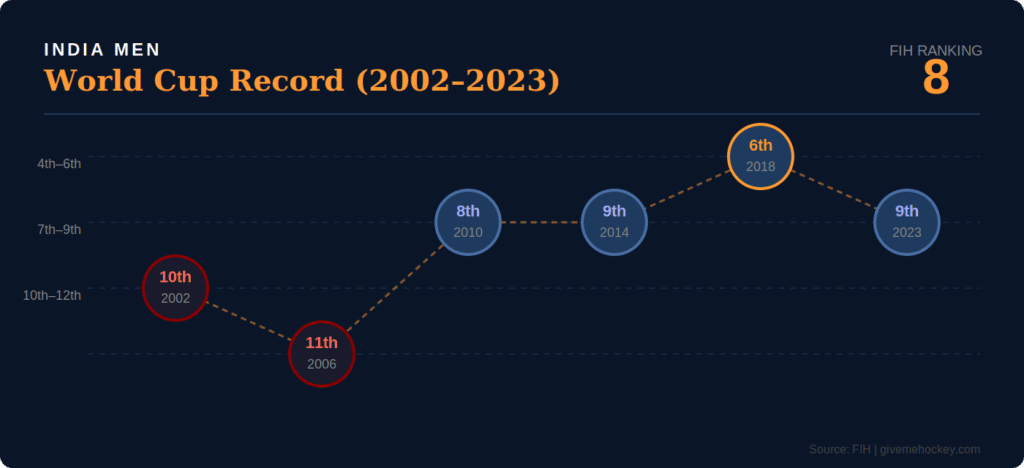
India’s World Cup record tells two very different stories depending on which era you look at. The early editions were remarkable: bronze in Barcelona in 1971, silver in Amsterdam in 1973, gold in Kuala Lumpur in 1975. India were the dominant force in world hockey and the World Cup reflected that.
What followed was a steady decline. India have participated in all sixteen editions of the tournament and since the turn of the century have not finished better than sixth, which came in 2018 under coach Harendra Singh. The 2023 World Cup on home soil was supposed to be the turning point. India had won Olympic bronze in Tokyo, the expectations were enormous, and the tournament was held in Bhubaneswar and Rourkela. Instead, India finished ninth. Graham Reid was sacked shortly after.
Qualification
India qualified for the 2026 World Cup by winning the Asia Cup in Rajgir, Bihar, in September 2025. The tournament, held at the newly built Rajgir Sports Complex, saw India beat South Korea 4-1 in the final to claim their fourth Asia Cup title. The only moment of concern came in the Super 4s stage, where India drew 2-2 with South Korea before emphatically reversing that in the final.
The qualification route was comfortable, and that is worth acknowledging honestly. Pakistan withdrew from the tournament citing security concerns, replaced by Bangladesh. Even with a full Asian field, the competitive gap between India and the rest of Asia has widened significantly. Winning the Asia Cup told us India are the best team in Asia. It told us little about how they will perform against the world’s best.
Recent Form and Build-up
2026 Form
| Played | Won | Drawn | Lost | Scored | Conceded | Goals/Match |
| 16 | 4 | 5 | 7 | 31 | 39 | 1.94 |
Source: FIH | givemehockey.com
Goals in 2026
| Total Goals | Field Goals | Penalty Corners | Penalty Strokes |
| 31 | 16 (52%) | 13 (42%) | 2 (6%) |
Source: FIH | givemehockey.com
Judge India purely by their FIH Pro League finishing position and the picture looks poor. India ended the campaign eighth, above only Pakistan who were relegated. But the Pro League had two very different halves.
In Rourkela, India lost all four matches. The 0-8 defeat to Argentina was the low point of the campaign, heavy, disorganised and deeply concerning. The European leg told a different story. India beat the Netherlands 3-2 and Germany 3-1 in Rotterdam before moving to London, where they lost 2-1 to Germany the following day, beat Pakistan twice at 4-3 and 7-1, and split the two shootout contests against England, winning one and losing one. The on-field performance in Europe suggested a team that had found its shape at the right time.
This fits a pattern Craig Fulton has established. Before the Paris Olympics, India’s preparation results were poor by any conventional measure. Fulton was not chasing results. He was managing load and testing combinations. India arrived at Paris ready to compete and won bronze. The European Pro League leg suggests the same process is underway ahead of August 15.
Craig Fulton’s Coaching
The most significant shift in Indian hockey over the last several years has been the move away from the all-out attacking style that defined the team for decades. Under Fulton, who built on the foundations laid by Graham Reid, India have become a structured, defensively disciplined side that counter-attacks with pace and precision.
The tactical identity is clear: hold the defensive shape, press to win the ball back quickly, and hurt opposition through transition. The GB match at the Paris Olympics, where India defended with ten men for over an hour after Amit Rohidas received a red card and still won on shootouts, is the clearest example of what this system looks like under extreme pressure.
Read More: Fulton’s Blueprint Comes to Life
India’s dependence on penalty corners remains both a strength and a vulnerability. In this writer’s view, Harmanpreet Singh remains the best dragflicker in world hockey, and he is central to how India score. When he is on, India are a different team. The concern is what happens when opposition defences neutralise that threat.
Squad Balance
The most talked-about omission from the squad is Krishan Pathak. For six to eight years, Pathak was PR Sreejesh’s trusted understudy and was expected to become India’s number one goalkeeper after Sreejesh’s retirement. He has not been considered for selection. Hockey India officially listed him as rested, but media reports suggested a disciplinary issue. Craig Fulton has gone with Mohith HS and Suraj Karkera as his two goalkeepers.
The other selection that raises eyebrows is Aditya Arjun Lalage ahead of Raj Kumar Pal. Lalage has just thirteen caps for India. Raj Kumar Pal was part of the Pro League squad. Taking a player with thirteen international appearances into a World Cup is a significant gamble, and Lalage will need to justify Fulton’s faith quickly.
The rest of the squad is largely as expected. Harmanpreet Singh captains the side. Manpreet Singh, India’s most capped player, anchors the midfield alongside Hardik Singh, Vivek Sagar Prasad and Nilakanta Sharma. The forward line features Abhishek, Sukhjeet Singh, Dilpreet Singh, Shilanand Lakra and Mandeep Singh, who was sharp and effective in the European Pro League leg. Fulton’s quote on the squad: “the right mix of tournament experience and in-form youth who’ve earned their spot through performance, not reputation” reflects the balance he has tried to strike.
Players to Watch
Harmanpreet Singh is the obvious name, but the question around him is more interesting than simply whether he scores. We have previously examined how his defensive positioning has been a concern and how he offers significant value in a deeper midfield role through his vision and passing. He was rested for one of the England games in the Pro League and India performed well without him. Fulton will need to decide exactly how and where Harmanpreet is deployed, and that decision could shape India’s entire World Cup.
Read More: Could Harmanpreet Singh Be More Effective in Midfield?
Hardik Singh is the player India’s midfield runs through. When he controls the tempo, India look a different team. The concern has been India’s inability to move the ball smoothly through the middle, with the team repeatedly forced into long balls and aerial passes to reach the forward line when the midfield has not functioned. Hardik’s ability to manage the game and reduce that gap will be central to how far India go.
Sukhjeet Singh has formed a productive partnership with Abhishek in the forward line. He scored three goals in the European Pro League leg, with strikes against Pakistan and the Netherlands. He is direct, quick, and effective in transition, exactly the kind of forward Fulton’s counter-attacking system needs.
Strengths and Concerns
India’s defensive structure is their biggest strength, and for a team historically known for attacking hockey, that is a remarkable transformation. Fulton has built a side that is difficult to break down and dangerous on the counter.
Penalty corners are the second major strength. Harmanpreet Singh is the best in the world at what he does, and India’s ability to manufacture and convert set pieces gives them a route to goal against any opponent.
India’s midfield, despite the quality of Hardik, Manpreet and Vivek, has struggled to control matches. The team has repeatedly been pushed into bypassing the middle entirely. Field goals have also been harder to come by than the squad’s attacking talent suggests. India scored 31 goals across 16 Pro League matches, but 11 of those came against Pakistan in two games. Strip those out and the numbers are thinner.
The goalkeeping position is an uncertainty. Suraj Karkera is a reliable option. Whether Mohith HS can handle the pressure of a World Cup, without the experience of Krishan Pathak behind him, is a question that may only be answered during the tournament itself.
Group Stage
Head-to-Head Record vs Pool D Opponents (Since 2020)
| Opponent | Played | Won | Drawn | Lost |
| England | 9 | 2 | 6 | 1 |
| Pakistan | 8 | 7 | 1 | 0 |
| Wales | 2 | 2 | 0 | 0 |
Source: FIH | givemehockey.com
India are in Pool D alongside England, Pakistan and Wales, playing all group matches at the Wagener Stadium in Amstelveen. On paper this is a kind draw.
Pakistan are not the force they once were. India have won seven of their last eight meetings since 2020, including a 10-2 victory at the 2022 Asian Games and a 7-1 win in the recent Pro League. Wales remain the lowest-ranked side in the pool and are not expected to challenge India for a top-two place.
England are the real test. The head-to-head record since 2020 tells you everything: nine matches, two India wins, one England win, six draws. The two Pro League meetings this year produced two draws, both going to shootout with one win apiece. The match on August 17 in Amstelveen will likely decide the top spot in the pool, and neither side has a clear edge.
Progressing from Pool D to the second group stage should be within India’s reach. That is where the tournament truly begins.
Expectations
India’s likely second group stage opponents, based on the current bracket, are Netherlands and Argentina from Pool A. This is where the campaign could end, or where it could be defined.
The Netherlands are the benchmark. Argentina have been a formidable force for years. Navigating that second group stage to reach the semi-finals would represent India’s best World Cup performance in fifty years.
Given two consecutive Olympic bronze medals, the progress made under Fulton, and the relatively kind pool draw, an exit at the second group stage would be a disappointment. Indian hockey fans and the sport’s ecosystem have invested too much in this rebuild to accept anything less than a semi-final.
The 2026 Hockey World Cup gives India their best chance in fifty-one years to end the wait. Whether they take it begins on August 15.
World Cup Hub: Looking for more coverage of the 2026 Hockey World Cup? Visit the Give Me Hockey World Cup Hub for previews, analysis, and match coverage throughout the tournament. Hockey World Cup 2026
Want our best work delivered straight to your inbox? Subscribe to the Give Me Hockey newsletter on Substack and get World Cup coverage, analysis, and more throughout August. Subscribe here


Comments are closed for this article.