

When India arrived in Rotterdam, the feelings around the team were mixed. The results from Rourkela and Hobart had not been good. But one question kept coming back: peaking at the right time.
For years, European teams have treated tournaments like the Pro League as preparation, rotating squads, mixing youth with experience, managing minutes. The Champions Trophy was always a good example, European sides arriving with mixed teams while India treated every match as must-win. With Fulton, that has changed. India have started approaching these tournaments the same way, building toward the World Cup rather than chasing points in June.
From an analytical standpoint, the winless record was not alarming. From a results perspective, carrying zero wins into matches against Netherlands and Germany was a real concern. Results affect morale, and India needed something from this leg.
What Rotterdam showed, across all four matches, was a team building something. The counter-attacking urgency, the sharpness of the transitions, the defensive shape holding even when results did not go their way. These were not the signs of a team chasing points. The final match against Netherlands was where that plan looked complete.
Read More: Peaking at the Right Moment: The One Thing That Will Define India at the 2026 FIH Hockey World Cup
Craig Fulton’s Blueprint: How India Defend and Counter
Craig Fulton’s India looks like a well-oiled machine. Accurate, sharp defending, followed by quick, deliberate counter-attacks. There is no panic. Ten years ago, watching India defend was a different experience, there was anxiety in the shape, uncertainty in the recovery runs, a sense that one good move from the opposition could unravel everything.
Fulton arrived after the 2023 World Cup with a clear idea. Defend in numbers, win the ball back, and counter before the opposition resets. It was a shift from the attacking hockey India had been known for. Paris 2024 answered the question of whether this approach was right. India had not beaten Australia in eight matches before that game, including a 7-0 at the Commonwealth Games and a 7-1 at Tokyo. At Paris, through control and structure, they won 3-2, their first Olympic win over Australia since 1972.
Paris was the answer.
There are anomalies. Germany’s second leg in Rotterdam, where India surrendered a lead in the final minutes, was a lapse in concentration. Five minutes of losing focus can change a game. But those are exceptions. The overall pattern, in Rotterdam and before it, has been a defensive performance getting sharper with each match.
Read More: Could Harmanpreet Singh Be More Effective in Midfield?
The Castle: How India Shut Netherlands Out
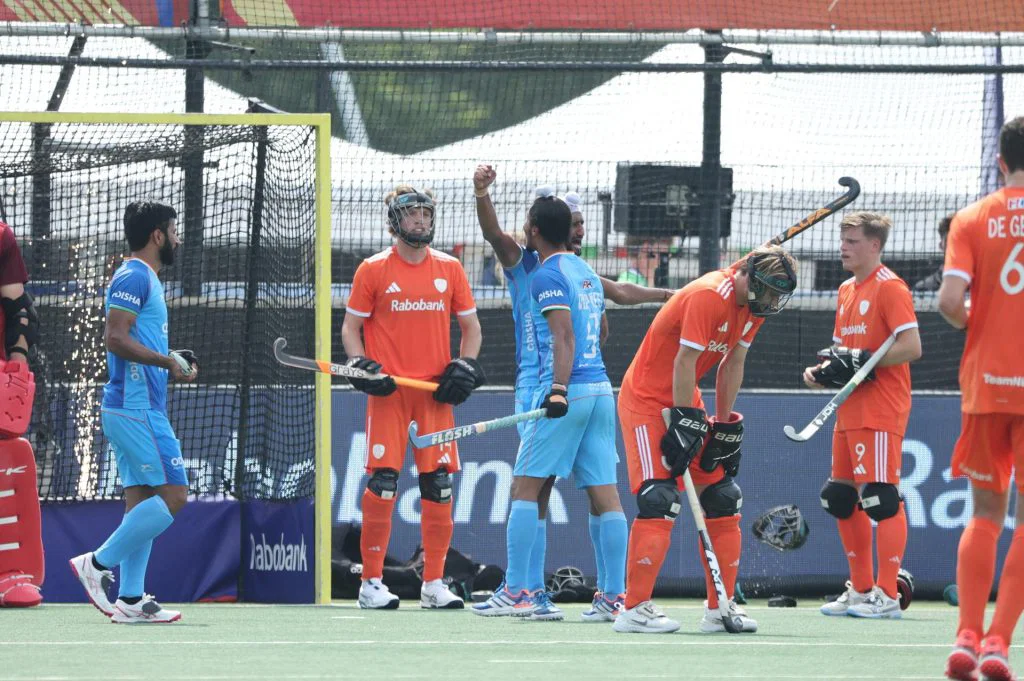
Netherlands did not get an inch in the final match. Every ball was contested and every piece of space had to be earned.
In a castle, the enemy sieges one door, and behind it they find another set of defensive positions already prepared. That is how India defended. If one player was beaten, at least two more were covering that same space. Netherlands worked for every ball, every inch of turf, and individual brilliance could not find a way through because another wall was always waiting.
Netherlands’ only real outlet was the wide wings, using pace to come in from wide corners. India’s zonal shift dealt with that too, tracking the movement, covering the angles, taking the ball before it became dangerous. Thierry Brinkman, one of Netherlands’ most dangerous players, could not find the space or the influence Netherlands needed from him across either Rotterdam leg. The castle had no door he could open.
The clearest proof came in the final minutes. Netherlands were reduced to ten men and threw everything forward, winning three consecutive penalty corners in the 58th minute. India blocked all three.
At the third quarter break, with India leading 2-1, the Netherlands bench told its own story. Delmee looked concerned. Players sat with lines on their foreheads, the look of a team asking itself why it could not unlock the Indian defence, why there was no space, and why even when space appeared, it was not working.
The Counter-Attacks That Unlocked the Game
India’s defensive structure was not built to absorb pressure and hold on. The second half of the plan was always transition, winning the ball back and moving into dangerous areas before Netherlands could reset.
In the third minute of the second quarter, Rajinder Singh stole the ball from a Dutch player in their own half. One touch to control, then a forward drive to the right, forcing a circle penetration. The sequence that led to India’s second goal started from that steal. The long corner that followed was played to Jarmanpreet Singh on the Dutch right wing. Finding no space, he played it back to Sanjay, also in the Dutch half, whose long slap shot found Abhishek, who finished with his trademark reverse stick first-time strike.
When Manpreet Singh was fouled near the halfway line, India had not even restarted play before Jarmanpreet had already gone long on the Dutch right wing and beaten his marker. The counter was already in motion before the restart.
Craig Fulton, speaking at half-time, said: “Ours is counter, getting the ball in their half and managing the ball better and taking chances.”
Netherlands coach Jeroen Delmee, also at half-time, said: “India has a quality to punish you through circle penetration. Tempo in turnover is what I was looking for.” India found it in the second half.
How India’s Fitness Made the Blueprint Work
India pressed high with their attackers as the first line of defence in the opening quarter, shifting to a mixed press as the match developed. The shape held from the first minute to the last.
There were lapses. The goalkeeper was called into action in the 3rd minute. A defensive error in the 13th minute briefly gave Netherlands an opening. The recovery was immediate, and the lapse in the 13th minute was converted directly into a turnover before Netherlands could capitalise, even inside the D.
Sumit, a centre-back, was on the wings in the second quarter, accepting high balls and joining India’s attack. Jarmanpreet, a right-back, was already in the Dutch half before India had even restarted after Manpreet’s foul. Defenders contributing in attack, recovering from lapses instantly, still available for the counter. Sixty minutes of this demands serious conditioning. And when the structure holds that well, the goalkeeper becomes the last wall rather than the first line of defence. The saves came, but they were standard ones. The hard work was done long before the ball reached him.
What Rotterdam Means for India’s World Cup Preparation
India head to London next, with matches against Pakistan and England. The World Cup is two months away.
The tactics, the defensive shape, the counter-attacking urgency, the fitness to sustain it across four matches against two of the world’s best sides. Rotterdam may not have delivered every result India wanted. But the blueprint is clearer now than it was when they arrived. That matters more than the points.
Enjoying this tactical breakdown? 2026 is a massive year for Indian hockey across the senior and junior ranks. Don’t miss a single blueprint shift—Subscribe on Substack to get unfiltered, analytical match reviews delivered directly to your inbox



Comments are closed for this article.