
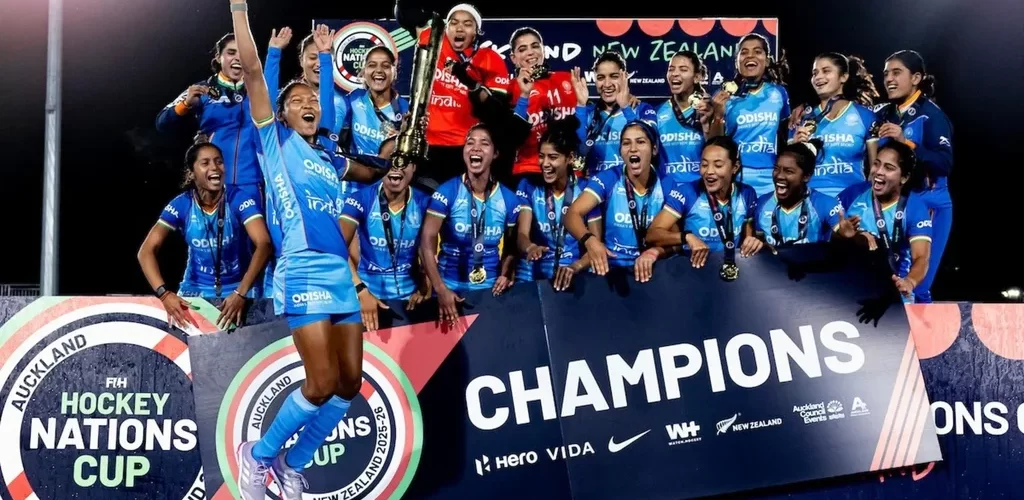
The Indian women’s team and the Indian men’s team are at very different points in their World Cup journeys. While the men chase a first World Cup medal in fifty-one years, the women are still working to establish themselves among the world’s elite. After the high of the 2020 Tokyo Olympics, where India reached the semi-finals for the first time, a period of change and transition slowed their progress. Sjoerd Marijne, the coach who guided India to that Tokyo semi-final, is back in charge. This is India’s ninth World Cup appearance and their third consecutive qualification, the first time in their history they have achieved that.
India’s World Cup History
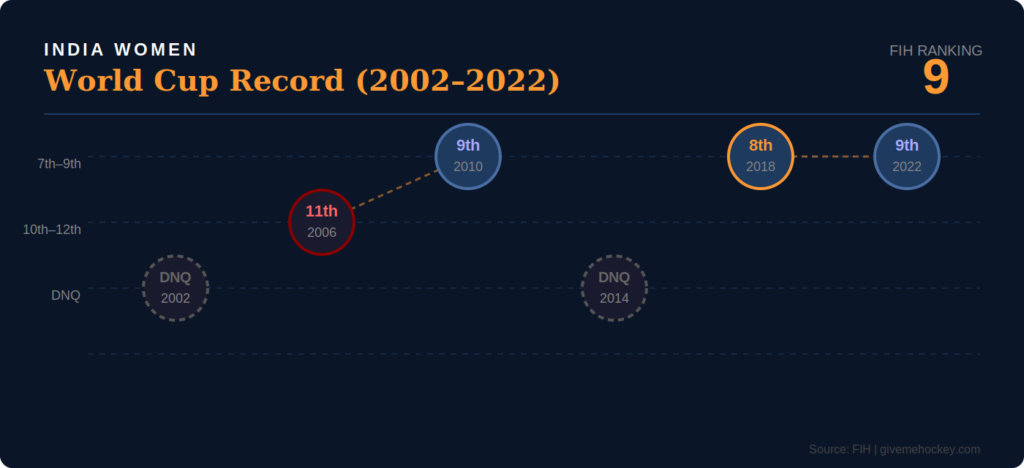
India’s Women’s World Cup record is largely one of absence and lower-half finishes. Out of fifteen editions before 2026, India participated in eight. The one exception to the pattern was the very first edition in 1974, when India finished fourth in Mandelieu, France. It remains their best-ever finish and their only semi-final appearance at the tournament. Since 2002, India have made four appearances and their best finish has been eighth, in 2018. They finished ninth in both 2010 and 2022.
Qualification
India’s route to the 2026 World Cup was not straightforward. The emergence of China as the dominant force in Asian women’s hockey, a process that accelerated significantly after Alyson Annan took over as head coach and delivered a silver medal at the Paris 2024 Olympics, meant India were no longer guaranteed direct qualification through the Asia Cup. At the Asia Cup 2025 in Hangzhou, India finished second. The final against China ended 4-1 to China. The final was not close. China were the better side and showed it convincingly.
That result forced India into the World Cup qualifiers in Hyderabad. The qualifier produced two results that raised questions. India drew with Scotland, a side ranked well below them. A mix of nerves and Scotland playing above themselves contributed to that result, and with the top three sides in the qualifier set to qualify regardless, it did not prove costly. The final against England ended 2-0 to England. India were tactically poor against a side that has itself been struggling, with England narrowly avoiding relegation from the FIH Pro League. It was also Marijne’s first tournament back in charge, and the rustiness showed. India qualified, but the manner of qualification left questions that the World Cup will need to answer.
Read More: Indian Men at the 2026 Hockey World Cup: Can 51 Years of Hurt Finally End?
Recent Form and Build-up
2026 Form
| Played | Won | Drawn | Lost | Scored | Conceded | Goals/Match |
| 10 | 8 | 1 | 1 | 27 | 10 | 2.70 |
Source: FIH | givemehockey.com
Goals in 2026
| Total Goals | Penalty Corners | Field Goals | Penalty Strokes |
| 27 | 19 (70%) | 7 (26%) | 1 (4%) |
Source: FIH | givemehockey.com
The FIH Nations Cup in New Zealand was India’s most significant result of 2026. They won the tournament unbeaten across five matches, with the final against New Zealand the standout performance. Defensively, India were excellent throughout, and particularly in the final. Deepika Soreng was outstanding at the back, not allowing the ball to pass her throughout. The Nations Cup showed a team that is difficult to break down and growing in confidence under Marijne.
The goals breakdown is the most telling number from 2026. Of India’s 27 goals, 19 came from penalty corners. That is 70 per cent of their total output from set pieces. Their biggest win of the year was a 6-0 result against Chile. India also toured Argentina and Australia for practice matches, winning one, drawing one and losing two in each tour. The quality of those opposition squads is difficult to assess, so drawing conclusions from those results in either direction would be wrong. In official FIH competition, the only genuinely strong side India have beaten this year is New Zealand, ranked 10th. England, ranked 6th, beat India in the qualifier final.
Sjoerd Marijne’s Coaching
Marijne’s return has brought stability to a side that went through considerable change after Tokyo. His first priority has been fitness, bringing the squad back to the physical standards he demands. The second is cohesion, building a group that functions as a unit rather than a collection of individuals. The Nations Cup win showed progress on both counts.
Tactically, Marijne has made penalty corners the cornerstone of India’s attacking play. The focus on winning and converting penalty corners has given India a reliable route to goal that did not always exist before. India are not yet capable of dominating the world’s best sides in open play, but the Nations Cup showed a team that opposing sides found difficult to break down.
Read More: Hockey India Names 20-Member Women’s Squad for 2026 Asian Games
One question has emerged in the days before the tournament. Reports in the Tribune, followed by the Times of India, revealed that Marijne was not with the squad during their recent training camp in India, instead spending time at home in the Netherlands. His contract apparently allows for this. India have other coaches and tactical support staff who were present throughout. It is not a cause for alarm for a side that was never going to be among the favourites, but for a team preparing for their biggest tournament in years, the absence of the head coach in the final weeks of preparation is a question worth noting.
Squad
Marijne has picked India’s strongest available squad with no significant surprises. The squad reflects continuity from the Nations Cup. Baljeet Kaur returns after being rested in New Zealand, which strengthens the midfield. Savita Punia will feature in her third World Cup, the most by any Indian women’s player. Three players who stood out in the Nations Cup, Deepika the penalty corner specialist, Navneet Kaur and Deepika Soreng, are all central to this squad and their form heading into the tournament has been encouraging. Salima Tete captains the side.
Players to Watch
Navneet Kaur is India’s most dangerous attacker right now. She contributes across all areas of India’s attacking play and supports the penalty corner unit with her striking ability. She scored in the Nations Cup final and contributed throughout the tournament, making her the most complete attacking option India have.
Deepika has been India’s most effective penalty corner conversion option. Her goals have allowed India to play with greater freedom, knowing there is a reliable route to the scoreboard from set pieces. Her form heading into the World Cup will be one of the most important factors in how far India go.
Deepika Soreng had an outstanding Nations Cup at the back. Her defensive work in the final against New Zealand was a significant reason India kept a clean sheet. At a World Cup where India will need to defend deep against China and England, her composure and reading of the game will be tested at a higher level.
Strengths and Concerns
The penalty corner is India’s clearest strength. With 19 of 27 goals in 2026 coming from set pieces, it is a defined and practiced weapon. Strong sides at this World Cup will specifically prepare to neutralise India’s PC unit. If that threat is taken away, India’s ability to create and convert from open play becomes the question.
Savita Punia’s experience is a genuine asset. India’s defensive structure under Marijne has improved and the Nations Cup showed a team that is difficult to break down. The concern is the quality of opposition India have faced in their best results this year. Winning the Nations Cup against Nations Cup-level opposition is different from competing against China, ranked 4th in the world, or England, ranked 6th. England have also played significantly stronger opposition than India in the lead-up to the World Cup, which means they will arrive better conditioned for the level of competition.
Group Stage
Head-to-Head Record vs Group D Opponents (Since 2020)
| Opponent | Played | Won | Drawn | Lost |
| China | 14 | 6 | 1 | 7 |
| England | 7 | 2 | 3 | 2 |
| South Africa | 6 | 5 | 1 | 0 |
Source: FIH | givemehockey.com
India are in Group D alongside China, England and South Africa. China are ranked 4th in the world and have been the dominant force in Asia since Alyson Annan took over as coach. Of India’s last five meetings with China, China have won four. The overall record since 2020 shows 14 matches played, with India winning six, China winning seven and one draw. The recent trend runs firmly in China’s favour. On current form, beating China in the group stage is beyond what this India side can realistically expect.
England, ranked 6th, are the real contest for second place in the group. The head-to-head since 2020 shows seven matches, with India winning two, England winning two and three draws. England beat India 2-0 in the qualifier final. They are the stronger, better-conditioned side. But England have been on a downward trend and narrowly avoided Pro League relegation. India have a chance, but England start as favourites for that second spot.
South Africa are the most manageable opponent. India have won five of six meetings since 2020, with one draw. Three points from that match is the baseline expectation.
Expectations
Reaching the second group stage would be a significant achievement for this India side. Two wins from three group matches would be enough to progress. The second win needs to come against England, and that is a genuine contest rather than a certainty. A close, competitive performance against China, even in defeat, would signal that the gap between India and the top four sides in the world is narrowing.
If India do not reach the second group stage, a strong defensive showing against China and at least one win against England or South Africa would still represent progress at this level. The 2026 World Cup is a chance for India to show that the Nations Cup win reflected genuine development, not just the level of the competition they were in. For a programme still finding its place among the world’s best, what happens in Belgium and the Netherlands will matter beyond the results.
Looking for more World Cup coverage? Visit the Give Me Hockey World Cup Hub for previews, analysis, and match coverage throughout the tournament.
Want our best work delivered straight to your inbox? Subscribe to the Give Me Hockey newsletter on Substack and get World Cup coverage throughout August. Subscribe to our mailing list.


Comments are closed for this article.