
Before coming to the Hockey World Cup, Indian coach Sjoerd Marijne had set his team a target of reaching the top eight. Five days into the tournament, India have achieved it.
A 0-0 draw against England secured India’s place in the championship pool and completed the target Marijne had set before the tournament. India needed a win or a draw, while England had to win, but there was little in India’s opening approach to suggest they were interested in simply protecting the qualification equation.
This was very much a game of two halves. India started with speed, direct passing and a midfield that moved the ball forward effectively. As the match developed, England became increasingly relentless and pushed India deeper, forcing the defence and both Indian goalkeepers to withstand sustained pressure.
India Put England on the Back Foot Early
India’s intentions were clear almost immediately. On one of their first attacks, they had possession on the left side of midfield with England covering the area well. Instead of trying to play through the pressure, India spotted a forward higher up and went over it with an aerial ball. Suddenly, only one defender and the goalkeeper stood between the Indian forward and goal.
That directness was a feature of India’s opening quarter. They moved the ball with speed, used longer passes when the opportunity appeared and got much better attacking support from midfield. The numbers reflected it: India had 67.8% possession in the first quarter, made six circle entries, took five shots and earned three penalty corners. England managed three circle entries, three shots and one penalty corner.
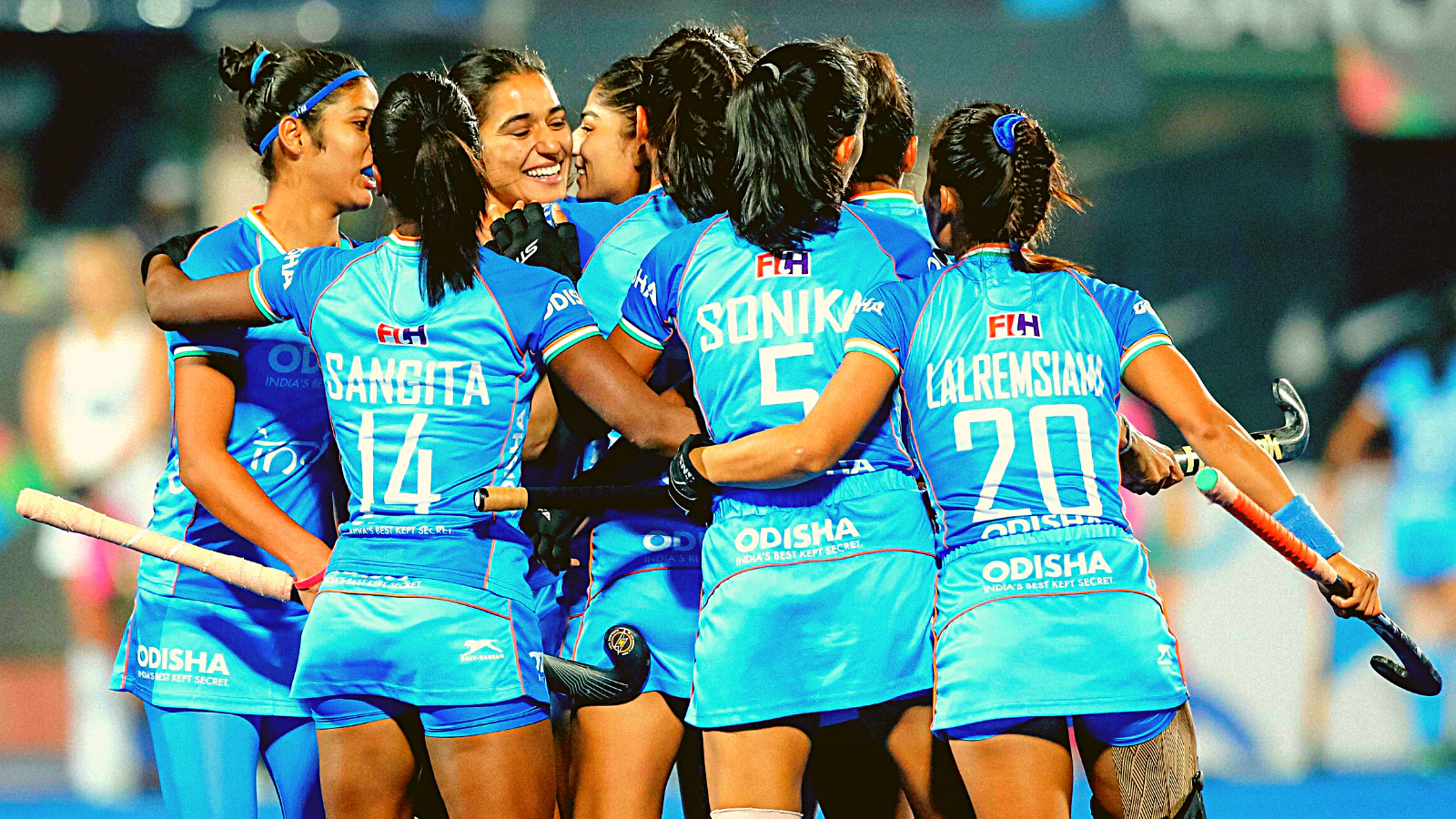
Lalremsiami was particularly effective when India moved forward. Her carrying, willingness to take players on and accurate passing helped India progress through midfield rather than simply sending hopeful balls towards the circle. One sequence later in the first half saw her spin between two England defenders and win another penalty corner, while India also produced some sharp passing combinations through the lines.
England began working their way back into the contest during the second quarter. Their possession increased to 55.3%, while they recorded six circle entries and three penalty corners compared with India’s three entries and one PC. India had made the stronger start, but the direction of the game was beginning to change.
England Turned the Second Half Into a Defensive Test

The contrast became much clearer after half-time. England needed a goal to stay alive in the tournament and began pushing India increasingly deep into their own half.
This was not India deciding to sit back and protect the draw. England were forcing them backwards. Darcy Bourne and Lily Owsley were increasingly involved as England tried to find routes into the circle, while India struggled to retain possession for long periods.
The statistics show how heavily the second half moved towards England. They had 60.1% possession in the third quarter and 59.2% in the fourth. Across those 30 minutes, England recorded 10 circle entries, 13 shots and seven penalty corners. India managed three entries and four shots.
By the fourth quarter, India were almost entirely defending. They produced just one circle entry and no shots or penalty corners, while England had four entries, five shots and two PCs. With five minutes left in the game, England took off their goalkeeper for an extra outfield player as they searched for the goal they needed. England had thrown the kitchen sink at India, and the response from the Indian defence was excellent.
Bichu Devi Stands Tall Under Late England Pressure
England finished with 20 shots, 19 circle entries and 11 penalty corners without finding a goal. That was not simply the work of one player. India’s first rushing, blocks, clearances and goal-line defending all contributed to keeping England out.
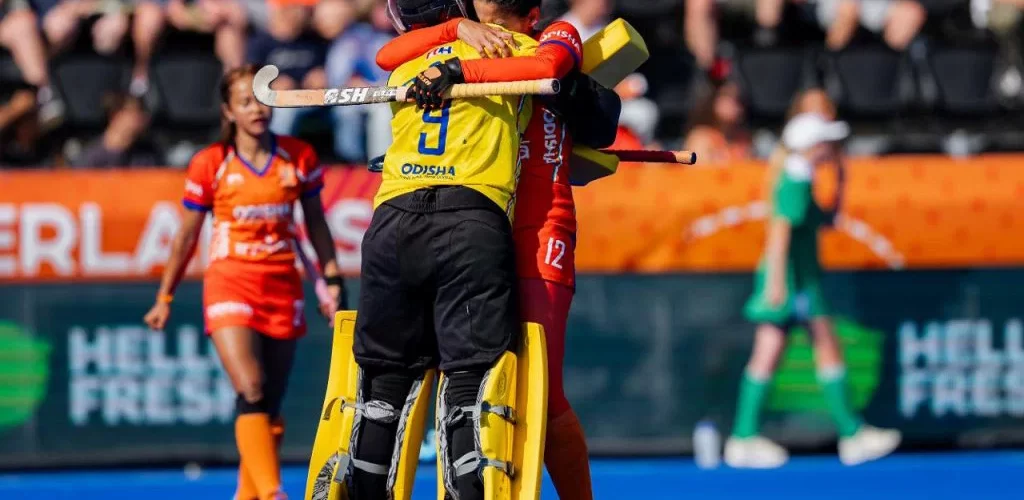
Bichu Devi Kharibam, however, produced the moment that defined the closing seconds. With 41 seconds left, Tessa Howard received the ball inside the Indian circle and got a reverse strike away towards the bottom corner. Bichu dived to her left and pushed the ball away with her outstretched glove. On the touchline, Marijne immediately threw his arms up in celebration.
Seconds later, the final whistle confirmed what that save had helped protect. India were through.
Marijne’s Top Eight Target Has Been Achieved
There are areas India will want to revisit before the championship pool. Allowing England 20 shots and 11 penalty corners shows how heavily the pressure built, while India’s inability to retain possession in parts of the second half made the defensive workload even greater.
Those questions can wait for the next game. This match was about achieving the target India brought into the World Cup, and they did it by showing two very different sides of their hockey.
The opening stages showed a team capable of attacking quickly, using the midfield effectively and bypassing pressure when space appeared further forward. The second half demanded something completely different as England pushed relentlessly for the goal they needed, and India responded with determined defending and a goalkeeper who delivered at the biggest moment.
India came to this World Cup looking for a place among the top eight. They have it now.
Follow the rest of India’s World Cup campaign, with updated results, standings, fixtures and analysis, on the Give Me Hockey World Cup 2026 Hub.
For the more personal side of the tournament, including daily reactions and things that do not always need a full article, follow the Give Me Hockey World Cup bulletin on Substack.




Comments are closed for this article.