
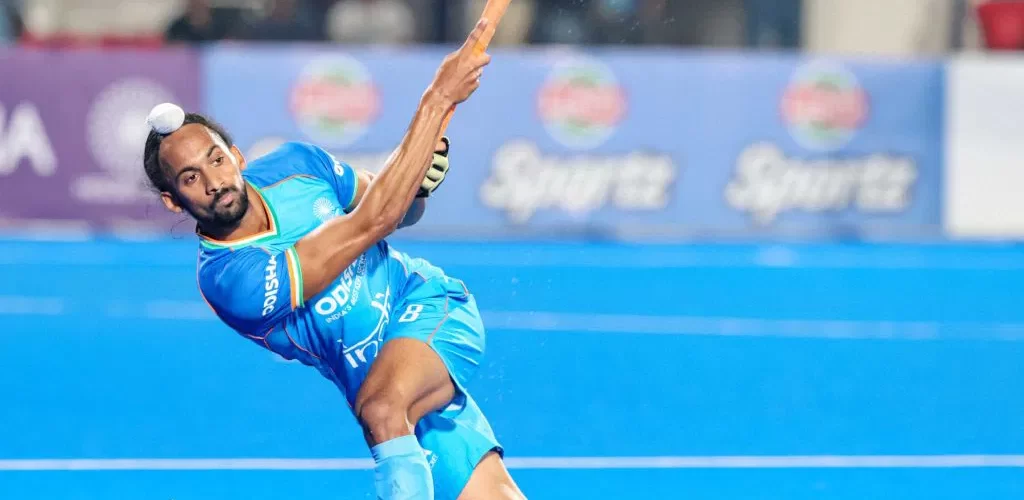
As expectations mount ahead of the India Men’s Hockey World Cup campaign, India arrive in Netherlands with two Olympic bronze medals, a coaching setup that has consistently delivered when it matters, and a European Pro League leg that showed what this side is capable of against the best in the world.
The wins over Germany and the Netherlands showed the level India can reach. But the Pro League also exposed problems that could hurt them at the World Cup. Some have been around for a while, while others became more visible over the course of the season.
India have not consistently controlled games through midfield. Their penalty corner still depends heavily on Harmanpreet Singh. The goal tally looks very different once the two Pakistan matches are taken out. Discipline has also hurt India before and remains a concern.
Then there is the occasion itself. This generation has won two Olympic medals, but India have not won a World Cup medal since 1975.
Here are the five areas where India Men’s Hockey World Cup campaign is won and lost.
Midfield: Elite Midfielders Without an Elite Midfield Unit
India have outstanding names in midfield. Hardik Singh, Manpreet Singh, Vivek Sagar Prasad, Nilakanta Sharma. Add the younger profiles of Rajinder Singh and Aditya Arjun Lalage and this is not a weak unit on paper. But names and units are different things.
Against elite opposition in the 2026 Pro League, India never led against Belgium in both matches and never led against Argentina in both matches. Against the sides they are most likely to face in the second group stage, India did not control a single game from the front.
The visual that stays with me is Hardik Singh dropping deep into the defensive zone to relieve pressure. That is his job. The problem is what happens next.
The central corridor ahead of him was empty. Nobody in the middle third to receive, nobody to drive the ball forward. India were left with one option: the long ball or the high ball, bypassing the midfield entirely.
Long balls and high balls are deliberate in Fulton’s counter-attacking system. They work when opponents give you space. Against better teams, that space is harder to find. If India do not win the second ball, possession comes straight back.
Then what?
India have the individual quality in midfield. What they have not done consistently against the better sides is control where the game is played.
Read More: Indian Men at the 2026 Hockey World Cup: Can 51 Years of Hurt Finally End?
Discipline: Can India Refuse the Game Their Opponent Wants Them to Play?
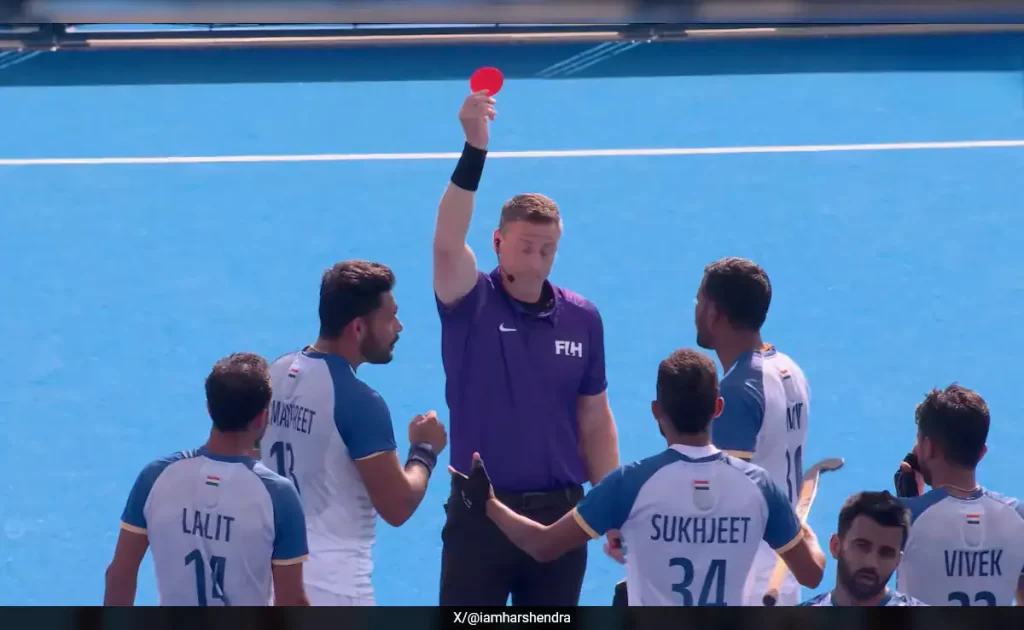
England do not play dirty hockey. They play uncomfortable hockey. They are good at disrupting India’s rhythm and India have not always reacted well to it.
At the 2022 Commonwealth Games, India led England 4-1. They did not win. England pulled it back to 4-4.
In the 2026 Pro League, Dilpreet Singh was carded after England got under India’s skin. In Paris, Amit Rohidas received a red card that left India with ten men for most of the quarterfinal. India survived and won the shootout.
That was a remarkable escape. India cannot rely on doing it again.
The green card data from the 2026 Pro League is another concern. India received ten cards across ten different players. Jarmanpreet, Abhishek, Dilpreet, Rohidas, Jugraj and Sukhjeet were among them.
Ten different players getting cards makes this a wider problem.
England know how to drag India into this kind of game. India will face them again at the World Cup. One card at the wrong moment could change far more than it did in Paris.
Penalty Corners: What Happens When Harmanpreet Is Not the Answer?
Harmanpreet Singh is one of the best dragflickers in world hockey. At Paris, he took 80 per cent of India’s penalty corners and scored 10 goals from them.
Craig Fulton has acknowledged how much responsibility that puts on one player.
“Harman got to a point where he took 80% of the penalty corners. He had 10 goals in Paris with penalty corners. That’s a huge amount of responsibility. If we can place 2-3 other players around him, it doesn’t always depend on him. That’s what we’ve been trying to build for the last 18 months since Paris.”
So, has it worked?
In the 2026 Pro League, India went 0 from 7 PCs against England, 0 from 5 against Argentina and 0 from 5 against Spain.
Seventeen penalty corners. Zero goals.
Belgium also depend heavily on their main penalty corner option. Alexander Hendrickx scored 15 goals in the Pro League, most of them from penalty corners. Hendrickx and Boon together accounted for 58 per cent of Belgium’s total goals.
India’s problem is what happens when Harmanpreet does not convert.
Opponents know he is the main threat. They will prepare their first rush accordingly. India need another option when that happens.
Rajinder Singh and Sanjay have been developed as alternatives over the last 18 months. At the World Cup, India may finally need them.
Goal Scoring: Do India’s Numbers Survive Scrutiny?
India scored 31 goals in 16 Pro League matches. That is 1.94 per match.
Remove the two Pakistan matches, where India scored 11 goals, and the number drops to 20 goals in 14 matches. That is 1.43 per match against non-Pakistan opposition.
The Pakistan goals count. But when 11 of your 31 goals come against one opponent across two matches, it changes how the overall number should be viewed.
Abhishek and Sukhjeet Singh, India’s main attacking options beyond Harmanpreet, scored 3 goals each from 16 matches. Dilpreet and Jugraj managed 4 each.
Against Argentina, Belgium, England and the Netherlands in 2026, India conceded more than they scored.
The wins over Germany and the Netherlands in the European leg are important. India showed how dangerous their counter-attacking hockey can be when it works.
The problem comes when it does not.
Fulton’s system is built around defensive organisation and counter-attacking hockey. India do not need to score four or five goals every game to make it work.
But there will be games at this World Cup when India concede first or the counter-attack does not produce enough chances.
Where do the goals come from then?
Read More: Which Teams Are the Favourites for the 2026 Hockey World Cup?
Occasion: Playing the Tournament, Not the Moment
This is the one I find most interesting.
India hosted the World Cup in 2018 and 2023. Both tournaments came with huge expectations. Both ended without the medal India wanted.
There were hockey reasons behind those results, so it would be wrong to simply blame the occasion. But India’s performances at the Olympics since 2018 make the contrast interesting.
Tokyo was different.
There were no spectators in the stands. Teams were living and training under Covid restrictions. India still had the pressure of trying to end a 41-year wait for an Olympic medal, but the environment around them was nothing like a home World Cup.
They beat Great Britain 3-1 in the quarterfinal and eventually Germany in the bronze medal match.
Paris showed that Tokyo was not a one-off.
When Amit Rohidas was sent off against Great Britain, India spent most of the quarterfinal with ten men. They did not collapse. They held their shape and won the shootout. After losing the semifinal, India came back and beat Spain to win another bronze.
India have now shown twice that this generation can handle the Olympics.
The World Cup has been different.
India have not won a World Cup medal since 1975. This tournament is away from home, so the environment will not be the same as 2018 or 2023. But two Olympic medals also mean expectations are higher now.
Maybe playing away from home suits this side. Maybe Tokyo and Paris have given them the experience they were missing before.
We do not know yet.
The Verdict
India’s European Pro League leg showed why there is genuine optimism going into this World Cup. They beat Germany and the Netherlands and showed that Fulton’s system can work against the best. But those results only tell one side of India’s story in 2026.
The other side is harder to ignore.
India still struggle to control games through midfield. Ten different players received green cards during the Pro League. The penalty corner returned nothing from 17 attempts against England, Argentina and Spain. Take away the Pakistan matches and the goals per game drop considerably.
None of these problems on their own means India cannot win the World Cup. India have already won major matches despite some of them. Paris is probably the best evidence of that.
The concern is what happens when two or three appear in the same match.
A midfielder drops deep and India struggle to play through the centre. The counter-attack stops producing chances. Harmanpreet gets rushed out at the penalty corner. Frustration creeps in. Someone gets a card.
That is how a World Cup match can get away from you.
India have spent the last few years proving they can survive difficult moments. Tokyo showed it. Paris confirmed it. This World Cup asks for something more.
Can India control those moments before they need to survive them?
Looking for more World Cup coverage? Visit the Give Me Hockey World Cup Hub for previews, analysis, and match coverage throughout the tournament. Check out our Hockey World Cup Hub
Want our best work delivered straight to your inbox? Subscribe to the Give Me Hockey newsletter on Substack. No fluff, no noise, just pure hockey. Subscribe now, it’s free.




Comments are closed for this article.