
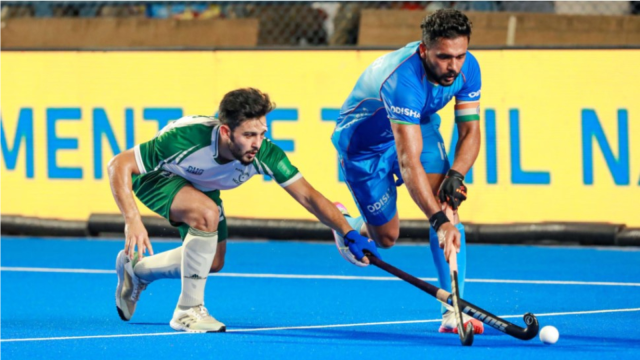
India vs Pakistan will always attract attention. The history is too big, the emotion around the fixture is too strong and, commercially, the rivalry still carries weight. On the field, though, the two teams are no longer at the same level.
India have spent the last few years playing regularly against the best teams in the world. Pakistan have shown signs of improvement, but their hockey still feels raw compared with the structure, fitness and tactical discipline demanded at the top level today. That does not mean Pakistan cannot create moments, but India should still be expected to win.
The defeat to England has added a small question mark around India, especially after the way the midfield became stretched in the second half. It has not changed the basic expectation for this game. Pakistan are not Belgium or England, and India should not have to approach this match with the same level of concern.
Pakistan Still Have Skill, but Modern Hockey Demands More
Pakistan’s traditional strengths are still visible. Their players are comfortable carrying the ball, taking defenders on and trying to create through individual skill. That style can still produce moments, and against Wales there were signs of the creativity that has always been associated with Pakistani hockey.
The problem is that hockey has changed considerably over the last 15 to 20 years. Individual dribbling and long carries still have a place, but modern international hockey depends far more on fitness, pressing, recovery runs, quick ball movement, defensive structure and repeated exposure to teams playing at that speed.
One way to look at the modern game is roughly 50 per cent fitness, 25 per cent skill and tactics, and 25 per cent exposure against top opposition. That is not a scientific formula, but it explains the gap between these two teams reasonably well. Pakistan still possess the skill, but sustaining the intensity and tactical discipline required over 60 minutes remains a bigger challenge.
Their World Cup results so far reflect that. Pakistan lost to England and then drew with Wales. They can stay in games and they can create individual moments, but they have not shown the same level of control or consistency that India should be capable of producing.
India Need Better Midfield Coverage Than They Had Against England
India’s overall approach should not need to change for Pakistan. The defence-to-counter strategy still makes sense because India are at their best when they defend with structure, regain possession and then attack quickly before the opposition can settle.
The England defeat exposed one problem inside that system. India’s midfield became too stretched, especially once England increased their pressure, and the connection between defence, midfield and the front line weakened. That made it harder for India to move the ball out cleanly and gave England more opportunities to recover possession.
That is the area India need to manage better against Pakistan. Pakistan’s individual skill becomes more dangerous when the game is loose and players are allowed to carry the ball into open spaces. Better midfield coverage, quicker passing and tighter distances between the lines should make those dribbles and runs much easier to contain.
India have enough quality to control this contest, but the structure has to allow that quality to show. If the midfield becomes stretched again, Pakistan may find more space than they should.
Read More: India vs England Deep Dive: The Midfield Question India Cannot Ignore
Sufyan Khan Is Pakistan’s Clearest Threat

The clearest individual threat India need to respect is Sufyan Khan. His drag flick has become one of Pakistan’s biggest weapons, and his power makes every penalty corner dangerous.
Pakistan do not need long periods of control if they can keep winning PCs. One or two opportunities can bring Sufyan into the game, which makes India’s discipline around the circle important. It also creates an interesting contest with India’s first rushers and goalkeeper.
If Pakistan are going to make the game uncomfortable, their penalty corners look like the most obvious route. That is why India need to avoid unnecessary fouls around the circle and make sure Sufyan does not get too many chances to influence the match.
The England Defeat Does Not Change the Expectation
India’s 4-2 defeat to England naturally creates the question of whether another poor performance could make this game more difficult than expected. That possibility always exists, and the first Pro League meeting between India and Pakistan showed that Pakistan can stay close when India do not completely control the game.
The difference is player quality. India have more experience against top opposition, more tactical structure and a greater ability to maintain their intensity over the full match. Pakistan can produce moments of individual brilliance, but producing those moments consistently enough to control India is a different challenge.
The England result should therefore not change the expectation. India should still be expected to win, although there may be uncomfortable periods if Pakistan earn penalty corners or India allow the midfield to become open again. Over 60 minutes, India have too many advantages for this to be treated as an even contest.
The history still makes India vs Pakistan a huge fixture. The current hockey does not.
World Cup Hub: Follow Give Me Hockey’s previews, reports, standings and analysis on the Hockey World Cup 2026 Hub.
Substack: For daily World Cup thoughts, reactions and shorter updates, follow Give Me Hockey on Substack.




Comments are closed for this article.