
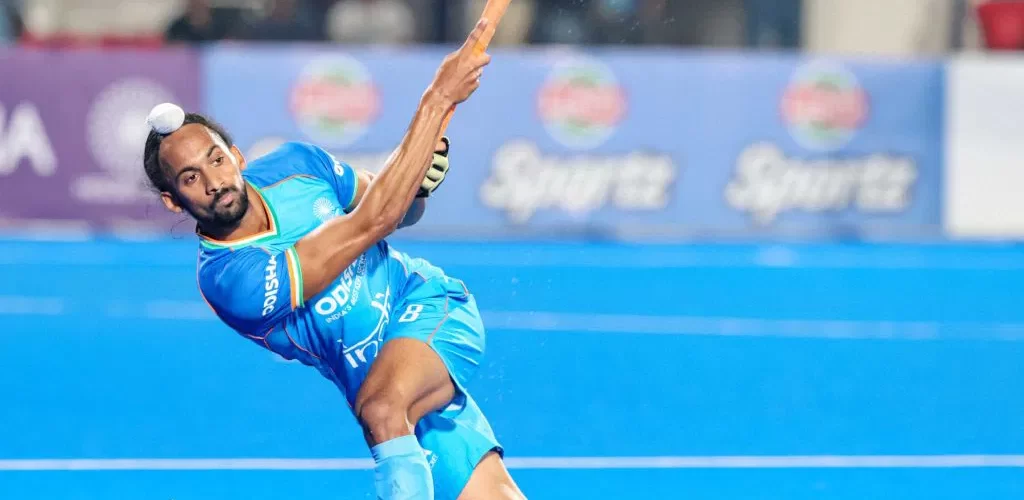
Four minutes changed India’s second World Cup match. Stuart Rushmere made it 2-2 in the third quarter, Henry Croft put England ahead soon after, and a 2-1 half-time lead had become a 3-2 deficit.
The scoreline changed quickly. The problems had started earlier. India were no longer moving the ball through midfield with the same control, England were pressing better, and recoveries that should have started counters were ending in turnovers.
Any India vs England analysis has to begin there. India had 42.6 per cent possession in Q3, produced no shot in the quarter and watched England score twice. It was the first time in the match that the defend-to-counter plan looked stuck rather than controlled.
That does not make Craig Fulton’s approach the wrong one. India had used the same basic identity only weeks earlier against Germany, the Netherlands and England in the Pro League, and it looked far sharper. The England defeat felt more like one bad day. There were still enough warning signs in the midfield to make it worth looking at why the plan stopped working.
The 4-3-3 Put Too Much Work on the Midfield
India’s 4-3-3 can become a very attacking shape once the wide players push high. That is useful when the counter is clean. Against England, it also left the three midfielders with a huge amount of space to connect.
From my match review, one Hardik Singh carry stood out. He collected the ball around India’s 25 and drove almost all the way towards England’s 25 and the edge of the circle. There was space in front of him, so the run made sense in the moment. The bigger question is why India needed their central midfielder to transport the ball that far.
The ball will always move faster than the player. A pass also makes the opposition move and gives the ball carrier support for the next action. When Hardik has to carry through that much of the pitch, England have time to recover, close the space and increase the chance of a turnover.
The forwards and wingers were already high and England were marking them well. That left Hardik with fewer useful options ahead. India could still go long, and both teams used plenty of aerials and longer passes, but the shorter connections around the ball were not always there.
Read More: Where India’s 2026 Hockey World Cup Will Be Won and Lost
England’s Press Took Away India’s Counter
This is where the third quarter numbers matter. England had 57.4 per cent possession in Q3. They made six circle entries to India’s three and scored twice. India did not register a shot.
The problem was not simply that England had more of the ball. India struggled to win it back and then struggled to keep it when they did. That meant the pressure kept returning.
India’s zonal defending was still doing a reasonable job of sending England towards wider areas. The defence was not being opened up with every attack. But a defence-to-counter team needs the counter to give the back line some relief. Once that threat disappeared, England could stay high, recycle the ball and attack again.
Rushmere benefited most. He had more room to influence the midfield and was involved in the two goals that turned the game. Harmanpreet Singh later described India’s errors as “silly mistakes”. From my match review, it looked broader than that. India were out-thought, out-positioned and out-tacticked during the period that decided the match.
A 3-1-3-3 Could Give India Another Route Through Pressure
One bad quarter is not a reason to throw away the 4-3-3. I would still like India to have another way of progressing the ball when a strong pressing team closes the first option.
One adjustment I would consider is a 3-1-3-3. Three defenders stay behind the ball, Harmanpreet plays as the deeper midfielder, Hardik operates centrally ahead of him, with Manpreet Singh on the left and Rajinder Singh or another rotating option on the right. The front three remain high enough to threaten, while the midfield line moves with the ball instead of the wide players immediately joining the forwards.
The personnel can change because hockey has rolling substitutions. What matters is the spacing. India would have another passing layer between the back three and the attacking line, while Hardik would not need to keep dropping deep to start every progression.
Harmanpreet is the interesting player in that shape. His value there would come from passing range and aerial ability rather than from treating him as a pure defensive stopper. He already plays like a free defender and can move the ball over distance accurately.
That is an argument I have made before. His defensive positioning has worried me, but his vision and passing can change where India attack from. Using him as the deeper distributor could leave Hardik closer to the areas where India need his carrying and creativity.
Related analysis: Could Harmanpreet Singh Be More Effective in Midfield?
The Structure Was Not the Only Problem
Moving one player deeper would not have solved everything against England.
India still created opportunities. They finished with 11 shots to England’s 10, made 18 circle entries and earned four penalty corners. Harmanpreet converted one of those four PCs, a 25 per cent return. India still had enough chances to make more of the game.
The return from open play was the bigger concern. Abhishek, normally India’s biggest goalscoring threat, had a quiet game. One reverse-stick effort went wide. Sukhjeet Singh struggled to influence the match.
The front line also looked disconnected when England were pressing, but India still got enough chances to make the game different. Better spacing may help India reach the forwards more consistently. It does not finish the chances for them.
The Goalkeeper Experience Question Was Already There
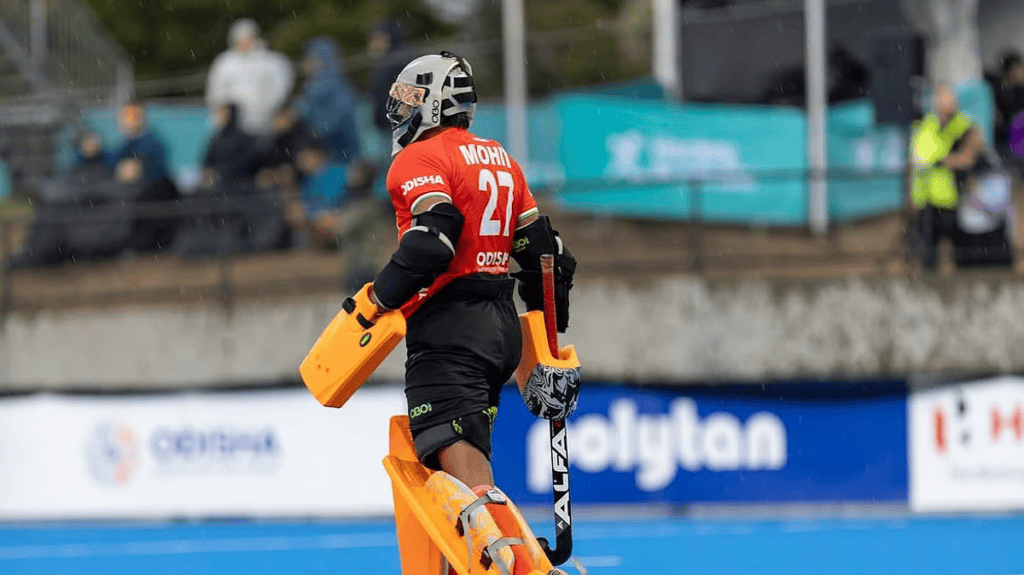
Mohith HS conceded three goals while he was on the field. None of that makes him responsible for India’s defeat.
The England game also does not prove that Mohith was the wrong World Cup choice. It reinforces a question that was already there before the tournament.
Hockey India’s pre-tournament squad profiles listed Mohith on 15 senior caps and Suraj Karkera on 89. Mohith is 24 and has shown enough to be part of the Indian setup. The concern is about how much responsibility a World Cup team should place on a goalkeeper this early in his senior career.
Goalkeeping is one position where experience matters heavily to me. Positioning, anticipation and the covering angle are built through games. A goalkeeper with 15 or 20 caps may have the reflexes and technique, but there are situations an experienced keeper has simply seen more often.
Part of that belief comes from football, where experienced goalkeepers are often valued for positioning and anticipation. Hockey is different, but I see the same principle in this position.
This is about the selection philosophy, not blaming Mohith for the defeat. The England match has not answered the experience question. It has brought it back into focus.
Six Weeks Ago, This Looked Like a Different India
The Pro League gives India a good reason not to overreact.
In the European Pro League leg, India beat Germany 3-1, lost the return match 2-1, beat the Netherlands 3-2 after losing the first meeting 3-2, and drew both regulation matches against England. England won the first shootout after a 2-2 draw, while India took the bonus point after the second game finished 0-0.
The anticipation looked better in those matches. The energy was better. The same basic tactical identity looked capable of surviving pressure and hurting elite opponents.
That context matters. England exposed a real midfield problem, but India had already shown that the same basic system can work against this level of opposition.
Was it the occasion? Was it simply a drop in intensity on the day? There is not enough evidence to answer that yet. One match cannot prove either explanation.
A Bad Day India Cannot Afford to Repeat
India can treat the 4-2 defeat as an off day. The Pro League performances give them enough evidence to do that.
They cannot ignore what happened in Q3. The midfield became stretched, the front line was too easy to mark, Hardik had too much ground to carry, and once England took away the counter, India spent too long defending without giving the defence a way out.
The World Cup format makes the result more expensive. If India and England both progress from Pool D, this defeat carries into the second group stage. India would then have to make up that ground against the qualifiers from Pool A, where the Netherlands and Argentina are among the teams in the race.
One bad day does not undo the hockey India played in Europe six weeks ago. The warning is that they may no longer have room for another one.
World Cup Hub: Follow the results, standings, previews, reports and analysis on the Give Me Hockey World Cup 2026 Hub.
Follow on Substack: India’s World Cup now moves to Pakistan, with the second stage still within reach and the margin for error smaller. Subscribe to Give Me Hockey for the match reports and the deeper analysis behind India’s tournament. Subscribe on Substack


Comments are closed for this article.